The Google Plus One button has been the late craze of both the SEO world and the social network marketers. It works wonders! It shares content and it increases your rankings in the search engines according to the quantity (and perhaps, quality) of the +1 of a webpage. Now that we have that established as a fact, a lot of black hatters would naturally come into play. How would Google control the spamming of the Google +1 button?
Lots of people are taking advantage
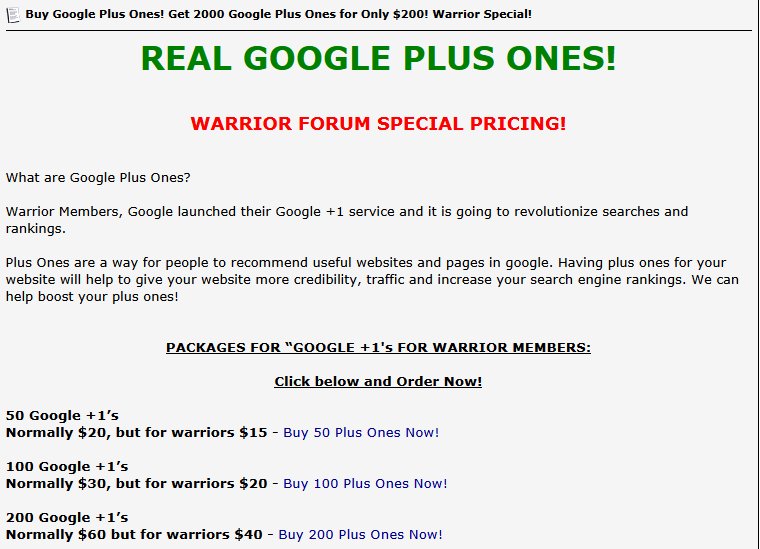
Why not sell a Google +1 service when it works? And that’s just what’s happening right now as many people try to abuse the ability of the +1 button to increase search engine rankings.
Quality as an indicator
One of the ways that Google claims to clean this up is by looking into the quality of +1′s by the relevance of the user who +1′d a page into all his other +1′s – kinda like Facebook’s Like button. The history of a user’s +1 tells a lot about the preferences and (for a lack of a better word) ‘likes’ of that certain user.
Google can see spam activities either by the rate of +1 a user is giving (and the quality of those +1′s) and by the rate a website is getting +1′s. Google can also make the +1 of all the other people in the Circles of that certain user as an indicator of the quality of that user’s +1. Relevance will set the tone for quality – and quality can set the tone for spam indication.
Google is now trying to make the Internet reflect Real-life
Social signals are based on people (and spammers). Twitter re-tweets, Facebook likes and Google +1′s are all action buttons executed by users for anything they want to share. Thus social signals can be a very powerful, user-driven factor usable for search engine rankings. Unfortunately, we live in an imperfect world with imperfect people – namely, black hat spammers.
Search engines are made for People and for Real life
So Google wants their social network to be based on real people and real life too. The result?
No more fake internet identities.
No more pseudonyms.
Google is now pushing for people to register their real names and identities as their Google profile. Perhaps someday soon, Google will even require people to have some sort of facial recognition access (remember, Google bought Pittpatt – a facial recognition company) in order for them to verify control of their user profile.
The advantages of this Identity System
It certainly makes the people who use the +1 button accountable for their actions. It makes them accountable for which page they want to rank higher in the search engines. Real people, real data, real search engine results.
Brilliant!
Except that people are afraid of the internet being accountable – some are even so paranoid as to say that it’s a Google-government tie-up.
The way things are heading: controlling the spamming of +1 means controlling the identification of spammers in the Google realm – no one wants to be identified as the person behind the spamming.
In the end, Google profiles might just be the most accountable database of users the internet will ever see. And as chances may have it, Google might just pull it off.


There’s a lot of potential for abuse. Black hat operators can pay people to block their competitors which means quality sites could disappear from the results. Google is not making things better, but worse.
We’ll have to see how they remedy their new innovations. Change can mean lots of things – there are advantages and disadvantages. Usually Google is a good player in fixing things with fast feedback loops.
The Google +1 button is similar to the facebook like button. However, I think the +1 button will dominate as the Google+ network grows.
No, its not at all the same as the FB Like button. Them both being buttons are the only similarity. Fact, G+ buttons actually controls organic search results, where FB Like buttons has little effect to search results. Many don’t realize that FB likes do have some impact on organic SERPs. But, that’s no a feature of FB. It’s simply a function of the SE’s
Dear Sean, I see… you are so young and naive.
You said…
“…some are even so paranoid as to say that it’s a Google-government tie-up”
Com’on Sean, wake up, and start looking around for more detailed and credible information about who Google is, and why they do pay just 2.5% taxes legally.
Hi Mike,
I take it you’re one of the people who view Google as a government tool. Even if it’s true, they almost own the web with their huge database of basically everything.
@Sean: Time will tell. The ONE good thing about the +1 button is Google Authorship, at least with this I can link my articles to my Google profile which gives me some protection against content thieves.
I share your point Joseph about Authorship being one major Google Plus advantage. I’m getting more into the guest blogging sphere and in particular this will be great in making sure I get credited for the work I’m putting out there.
BTW – great post Sean, as usual!
Rita recently posted..SEO – Use Content To Target Longtail Keywords
From the moment I heard of google+1 I thought it was too over simplistic and open to abuse. Its as simple as messaging your facebook friends and asking them to click your button. As a guess I would say that 75% of +1 clicks are from people with an agenda. I can see the +1 getting dropped within a year or its potential to boost ranking diminished.
@Mark: Pretty similar to people w/ an agenda blocking their competitors. There is a high probability that Google’s new “quality” promoting tools will be used by a large number of unscrupulous parties with the express intent of manipulating the search results. That’s why you can’t depend exclusively on Google for traffic; promote your business using Bing, social media and word of mouth.
To counteract spamming Google will definitely ask for a genuine profile of user, but this seems more fishy as Google once again takes every information user has to offer. I see this as a new policy to gather more & more data about each & every user.
If Google Plus take the advantage over Facebook … I don’t know where you leave but here no one (I mean the “real people”) care about Google Plus. It reminds me Twitter : only the geek use it.
But it’s fun to use iMacro of Mecanical Turk to make some test on ranking …
You are not lying, Sean. I was on Fiverr recently and there are a ton of people offering Google Plus 1 likes. I am guilty of contemplating it, lol.
Hahaha! Well, can’t blame you for feeling that way. Afterall, it does help some.
I would like to make an important point. People who think that buying google Plus Ones would badly affect the rank, then it would be so easy for me to buy plus ones for my competitors. Say I buy plus ones for my top 5 competitors for $20 each that would affect their ranking badly. Seems to easy, doesn’t it.
But does that really happen. I bet you can try if you think that paid plus ones are that bad. According to Google you can’t have paid links, but what all are doing in the name of SEO is buying link wheels, pyramids, contextual links,blog comments etc.
So, if Google is going to take any action than it would not surprise me if all those sites get deranked first that has done paid SEO.
My point is- Google plus one adds an extra layer of social recommendation and can be seen as a complimentary service to your current link building efforts. You won’t get rank 1 with just plus ones. And I doubt that it would be so easy to remove your competitors by firing them with paid plus ones.
Till this day Content is the KING.
Ive been seeing +1s for sale almost since the day I heard of the project. Even if they go the biometric route there can and will always be people willing to game or tilt the system. I applaud Google for taking efforts to curb it’s abuse though. I think we all want better more authentic results.
In the future, I can imagine more requests for +1s in emails going out to large subscriber lists if they make it a more prominent ranking signal…or any number of networks/groups/collectives etc. And for the mega black hatter/hackers…think of the new bots that will be coded to run on and through botnets. Ugh… My hats off to Matt’s team and what they have to fend off.