AI Search Is Ignoring You: Here’s Why Your Competitors Get Picked
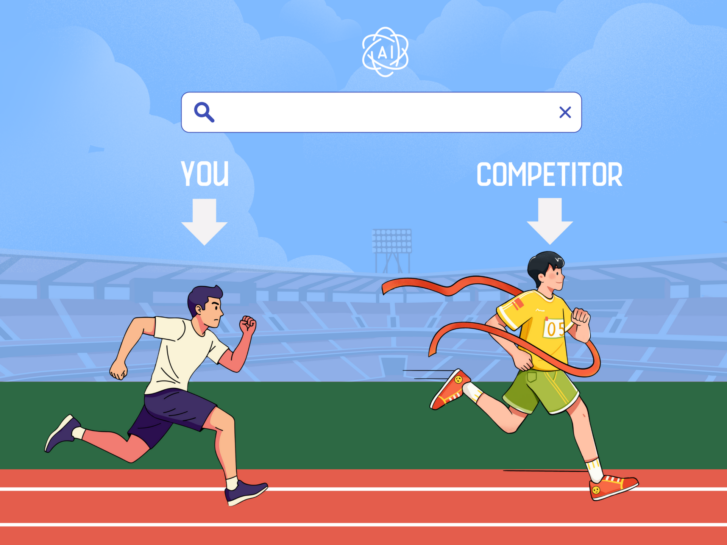
Let me say this upfront: AI search isn’t “unfair.” It’s just brutally honest.
Google, ChatGPT, Gemini, Perplexity, AI Overviews — they don’t feel your brand’s effort. They don’t care that you published 500 blogs last year. They don’t reward “hard work.” They reward signals.
And right now, your competitors are simply sending stronger AI search visibility signals than you are.
This reminds me of a principle we’ve lived by for years: great content is not enough — you need to market it. That was true in classic SEO, and it’s even more true now in AI SEO and AEO (Answer Engine Optimization).
AI search is basically SEO + reputation + PR + structure + consistency — all rolled into one big trust machine.
So if you feel like competitors are “winning” in AI search, here’s why.
Why do competitors show up more in AI search?
Competitors win in AI search because they build stronger authority signals, publish more extractable content, and earn more third-party mentions across trusted platforms.
That sounds simple. It’s not easy. But it’s straightforward.
AI systems don’t just look for answers. They look for answers they can safely repeat.
That means competitors with:
- more reputable backlinks
- more branded mentions
- more citations in industry sites
- more “people talk about them” signals
…get picked first.
It’s the same concept as a courtroom: the AI is asking, “Who has witnesses?”
Backlinks and mentions are those witnesses.
And here’s the part that stings: you can have the same quality content, but if they’re more validated, they’ll still get cited more.
AI SEO takeaway: authority signals still matter — and in AI search, they often matter more.
2) Your competitors write in a way AI can quote
Most websites write like they’re trying to impress a professor.
AI prefers content that’s easy to extract and justify — content that can be quoted cleanly in one paragraph, with a clear heading above it.
If your competitor does this:
H2: What is AEO?
Answer: AEO (Answer Engine Optimization) is the practice of structuring content so AI tools can extract clear, direct answers and cite your brand.
And you do this:
H2: Understanding the landscape
(then 6 paragraphs of background before the actual answer)
Guess who gets picked?
AI doesn’t hate you. It just can’t “pull” you.
So yes — BLUF works (Bottom Line Up Front). Give the answer early. Then explain.
This is why in my AEO/GEO series, I started with the shift that matters most: search behavior moved from keywords to conversations — and our content needs to match that reality.
AI SEO takeaway: write answers like they’ll be quoted — because they will be.
3) Your competitors dominate the places AI loves to reference
AI engines don’t only read your website. They also read the internet’s “public proof.”
Meaning: Reddit threads, G2 reviews, YouTube breakdowns, niche forums, Quora, community discussions — all that messy, human stuff.
If your competitor is present there, they become a familiar entity in the machine’s brain.
That’s why I keep telling people: citations are the new backlinks. Not because backlinks don’t matter — they do — but because AI is watching who gets mentioned consistently across the web.
And if you want the PH-specific context for why this public proof matters more than ever — and where Filipino brands are actually winning or losing attention online — I broke it down in the Digital State of the Philippines whitepaper. It’s the macro view that explains why AI visibility is now tied to presence, trust, and discoverability across platforms — not just your website.
AI SEO takeaway: if nobody talks about you outside your site, AI will struggle to recommend you.
Some brands publish like they’re playing bingo: “Let’s blog about this keyword. Let’s blog about that keyword.”
But the brands winning in AI search build a “topic fortress.”
They cover one topic deeply:
- definitions
- how-tos
- comparisons
- FAQs
- use cases
- mistakes
- templates
- troubleshooting
- pricing logic
- examples
So when AI tries to answer anything in that topic neighborhood, it goes: “Ah. This brand again. They keep showing up. They must be the authority.”
Topical authority is basically repeated excellence + repeated association.
AI SEO takeaway: AI rewards the brand that owns the topic, not the brand that posts occasionally about it.
5) Your competitors have clearer entities than you do
AI doesn’t just read words. It recognizes entities: brands, people, products, locations, services.
If your site is inconsistent (different naming, unclear positioning, messy About page, weak author bios, no schema, inconsistent NAP), you look “fuzzy.”
Fuzzy brands don’t get featured.
Clear brands do.
AI SEO takeaway: make your brand and offerings unmistakable to both humans and machines.
6) They make their claims verifiable (and you might not)
AI likes content it can defend.
So if competitors are:
- citing credible sources
- showing author credentials
- referencing data
- linking out properly
- using schema markup
…they become safer to cite.
And AI is obsessed with being safe.
AI SEO takeaway: the more verifiable your content is, the easier it is for AI to cite you.
What to fix first so you start showing up
If you want a simple priority order, here it is:
- Fix structure first (fastest ROI)
- Build mentions like your visibility depends on it (because it does)
- Build topic clusters, not “blogs”
- Get present where the internet has conversations
- Implement schema properly
Step 1: Fix structure first (fastest ROI)
On your key pages:
- Use question-style H2s that mirror real prompts
- Put the answer immediately under the header (2–3 sentences)
- Support it with detail after
- Link sources for claims/statistics
Step 2: Build mentions like your visibility depends on it (because it does)
PR, partnerships, guesting, expert commentary, community participation.
Your goal: be talked about in places AI already trusts.
Step 3: Build topic clusters, not “blogs”
Pick your core themes and cover them deeply until it’s obvious you’re the authority.
Step 4: Get present where the internet has conversations
If your market lives on Reddit, forums, LinkedIn, G2/Clutch/Capterra — you can’t be invisible there and expect AI to magically discover you.
Step 5: Implement schema properly
At minimum:
- Organization schema
- Website schema
- Article schema
- FAQ schema (when appropriate)
- Author schema (or strong author pages)
Here’s a beginner-friendly guide on how to implement schema on your website, if you need it.
Key Takeaway
AI search rewards brands that act like leaders.
Leaders don’t hide behind fluff. Leaders answer clearly. Leaders show proof. Leaders are present in the community. Leaders are consistent.
And that’s why this is not “a new strategy” — it’s SEO done at a higher standard, with PR and clarity working together.
If you want to win in AI search, you don’t need to “hack” the AI.You just need to become the brand the AI can confidently recommend.
And if you want the PH-specific context for why this is happening (and where Filipino brands are getting outpaced), I laid it out in the Digital State of the Philippines report — it’s the big-picture view of how discovery, trust, and online behavior are shifting locally, which directly affects how AI engines “decide” what to surface.
