Prompt Research for SEO: Going Beyond Traditional Keyword Research

For years, keyword research has been one of the first things I do when building an SEO strategy. I look at search volume, keyword difficulty, search intent, and competitor rankings to understand what people are searching for and how I can help a website become more visible.
That process is still important.
But as AI search continues to change how people discover information, I have started looking at another question: What are people actually asking AI when they are looking for a product, service, or recommendation?
This is where prompt research comes in.
Instead of focusing only on the keywords people type into Google, I also need to understand the questions, comparisons, and recommendations they bring to AI platforms. And with Semrush One, I can connect these two parts of SEO into a more comprehensive workflow.
What Is Prompt Research and Why Does It Matter?
Prompt research is the process of identifying and analyzing the questions people ask AI systems when they are looking for information, evaluating options, or making decisions.
I like to think of it this way: keyword research tells me what people are interested in. Prompt research tells me how they ask about it when they want a complete, conversational answer — and what context they bring to that conversation.
A traditional keyword might be: “SEO agency Philippines”
The equivalent AI prompt could be: “What should I look for when choosing an SEO agency in the Philippines for long-term organic growth?”
Both relate to the same topic, but the second query provides more context about the user’s needs. It tells me the user is not just browsing. They are evaluating, they care about long-term growth rather than a quick win, and they want criteria for making a decision.
This difference matters because this is how a majority of users search now, and AI search is designed to understand this search behavior shift. It takes these conversational questions and generates responses that address the context behind them. For SEO professionals, this creates effectively a whole new arena to compete for the top spot in. And, if you know how to shift from your tracked keyword lists to AI search prompts, then your brand could be the recommended answer that ChatGPT and other AI-powered search experiences give to your target audience.
I discussed this shift in greater detail in my guide on doing prompt research for AI SEO (also known as GEO, in this context). The main idea is that prompt research expands traditional keyword research rather than replacing it.
How a Keyword and a Prompt Are Different — Not Just Longer
At first, I treated prompts like long-tail keywords. That was a mistake.
A long-tail keyword is still a fragmented query: “best CRM software Philippines small business.” A prompt is a full decision-making scenario with layers built in.
When I compare them side-by-side, here’s what I actually see:
Keyword: “SEO agency Philippines”
What I learn: Topic + location. I don’t know the budget, timeline, business model, or what “best” means to them.
Prompt: “What should I look for when choosing an SEO agency in the Philippines for long-term organic growth?”
What I learn: Topic + location + evaluation criteria + timeline expectation (long-term) + goal (organic growth, not just traffic). That one sentence gives me at least three content angles: how to vet an agency, what realistic timelines look like, and how organic growth is measured.
In my experience, prompts almost always contain four extra signals that keywords hide:
- Situation: “for a growing Philippine business,” “for an ecommerce store doing international shipping”
- Constraint: “with a small team,” “without paid ads,” “with limited budget”
- Comparison intent: “compare X vs Y,” “what’s the difference between SEO and paid advertising?”
- Next action: “what should I invest in first,” “how do I migrate without losing…”
Why This Shift Matters for Visibility Right Now
I’m paying attention to this now because the SERP I optimized for five years ago no longer behaves the same way.
When Google shows an AI Overview, Perplexity gives a synthesized answer, or ChatGPT recommends three vendors, the user often doesn’t click 10 blue links. They read the answer. If my brand isn’t mentioned or cited in that answer, I’m invisible even if I rank on page one.
I’ve seen pages ranking #3-#5 get cited in AI Overviews while the #1 result is ignored, simply because the lower-ranking page answered the follow-up question more directly, had a clearer comparison table, or explained pricing and process better.
That’s the core change I’ve had to internalize: in traditional search I was optimizing to rank. In AI search I’m optimizing to be referenced.
How Keyword Research and Prompt Research Work Together
Keyword research helps me understand the language people use when searching for a topic. It also gives me a foundation for identifying content opportunities, evaluating competition, and planning landing pages.
Prompt research builds on that foundation by exploring how users might express the same needs in a conversational AI environment.
For example, a keyword such as “CRM software Philippines” can lead to prompts like:
- “What CRM software should a growing Philippine business consider?”
- “Compare CRM software options for a company that needs sales and customer support in one system.”
- “What should I look for when choosing CRM software for a small business?”
The keyword identifies the subject. The prompt adds context, intent, and a possible decision-making situation.
This is why I would not abandon keyword research when building an AI search strategy. Instead, I would use both to understand the complete search journey. Keywords show me where demand exists. Prompts show me what would actually satisfy that demand in an AI-generated answer.
From Keywords to Conversational Questions
When I begin prompt research, I first look at the keyword data I already have.
I review the keywords that are generating impressions, the terms competitors are ranking for, and the topics connected to my existing content. From there, I develop realistic prompts that reflect the questions a potential customer might ask.
For example, if I am working on a website offering SEO services, I might start with:
Keyword: SEO services Philippines
Prompt: “What SEO services should a Philippine business invest in if it wants to increase organic traffic and generate more leads?”
The prompt gives me more information about the user’s goal. It also helps me identify the type of content that may be useful, such as a service page, an SEO strategy guide, or a comparison of different approaches.
Here’s the simple expansion framework I use for every priority keyword cluster:
- Keep the core keyword as the anchor. Example: “ecommerce SEO services”
- Add who it’s for. Example: “…for a Philippine ecommerce business on Shopify?”
- Add the decision they’re trying to make. Example: “What are the best SEO strategies… vs running Shopee ads?”
- Add the outcome they want. Example: “…to get consistent organic sales in 6 months?”
So “ecommerce SEO services” becomes three trackable prompts:
- “What are the best SEO strategies for a Philippine ecommerce business on Shopify?”
- “Should I invest in SEO or Shopee/Lazada ads for long-term ecommerce growth?”
- “How long does ecommerce SEO take to generate sales in the Philippines?”
Each one maps to a different content type — a strategy guide, a comparison article, and an FAQ / expectations section on my service page. That’s how I turn one keyword into a full coverage plan.
How Semrush One Helps Me Transition to Prompt Research
This is where Semrush One becomes useful.
Instead of treating traditional SEO and AI search as completely separate workflows, I can use Semrush One to connect keyword research, AI visibility, competitor analysis, and content optimization.
Semrush One combines SEO and AI search insights in one platform, including keyword and backlink data, AI visibility tracking, prompt research, and website optimization capabilities. This allows me to move from identifying search demand to understanding how a brand appears in AI-generated answers.
What I like most is that I don’t have to jump between five tools. My keyword list, my prompt list, my AI mention tracking, and my content recommendations live in the same place. That makes the keyword-to-prompt transition practical instead of theoretical.
Here’s how I actually use it, step by step.
1. Start with Keyword Research
My first step remains traditional keyword research.
I use keyword data to understand what people are searching for, which topics have demand, and where competitors are already visible.
For example, I might discover that a website has opportunities around:
- SEO agency Philippines
- SEO services for small businesses
- Ecommerce SEO services
- Local SEO services
I would then group these keywords according to search intent and the pages I want to optimize.
This gives me a structured starting point for prompt research.
In Semrush One, I typically start with Keyword Overview and Keyword Magic Tool to validate volume and difficulty, then use Position Tracking and Keyword Gap to see where competitors are beating me. I’m not just looking for high-volume terms. I’m looking for clusters where I already have impressions in Search Console but weak coverage — those are usually my fastest prompt wins.
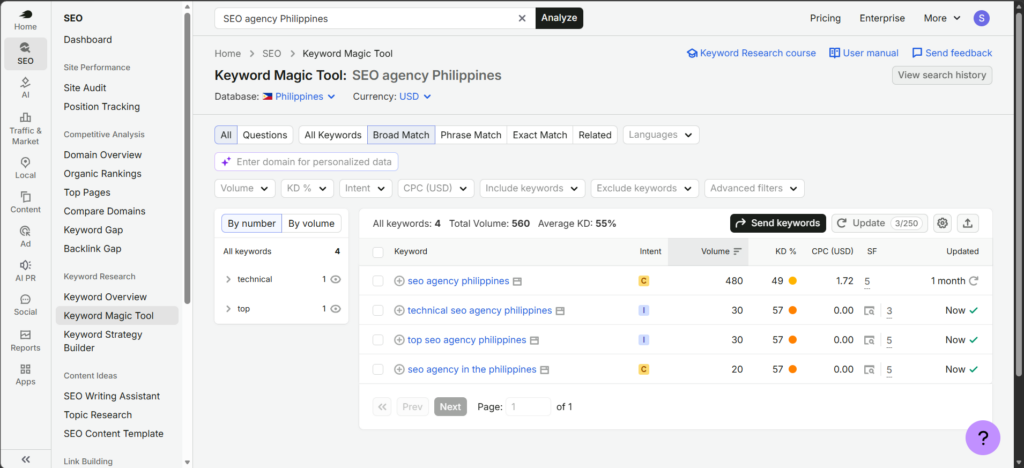
Once I have those clusters, I map each one to a primary page. For instance, “SEO agency Philippines” and “best SEO agency Philippines” go to my homepage or agency page, while “ecommerce SEO services” and “SEO for Shopify Philippines” go to a dedicated service page. That mapping becomes the skeleton for my prompt list.
2. I Use Prompt Research to Understand AI Search Demand
After identifying my keyword clusters, I move to prompt research.
Semrush One includes prompt research capabilities that help marketers discover the keywords, topics, and prompts connected to AI search demand. I can use this to explore how users might ask AI systems about a particular subject and identify opportunities to create content that addresses those questions.
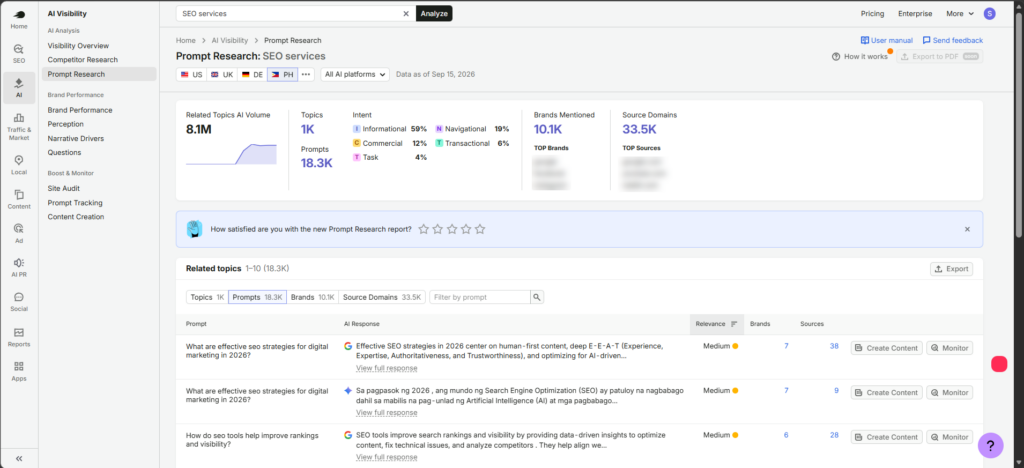
When I review prompts, I look for questions that reflect real business needs.
For example:
“What are the best SEO strategies for a Philippine ecommerce business?”
This prompt gives me more than a keyword. It tells me that the user may be evaluating strategies and looking for an approach suited to a particular business model.
I can then use that insight to improve an existing service page or create a supporting article.
To keep this from becoming overwhelming, I score every prompt on three things:
- Business relevance: Would this person ever become a customer? A prompt like “what is SEO” is educational but low priority. “What SEO services should I invest in first with a 50k monthly budget” is a high priority.
- Decision proximity: Is the user comparing, validating, or ready to contact? I prioritize comparison and validation prompts because those are what AI Overviews and ChatGPT cite most for B2B services.
- Content feasibility: Can I answer this credibly with data, process, case studies, or first-hand experience? If not, I either need to create that proof or deprioritize the prompt.
That scoring is what turns a list of 200 prompts into a top 20 I actually track and create for.
3. I Track How My Brand Appears in AI Search
Keyword rankings tell me where my website appears in traditional search results.
AI visibility tracking helps me understand how my brand appears in AI-generated answers.
Semrush One allows me to track AI mentions and visibility alongside traditional SEO metrics. This is useful because a brand may have strong organic rankings but still have opportunities to improve how often it appears in AI-generated recommendations.
For example, I might track prompts related to:
- Best SEO agency in the Philippines
- SEO agencies for ecommerce businesses
- SEO services for companies expanding internationally
I can then monitor whether my brand is mentioned, how often it appears, and which competitors are being included in the same answers.
This gives me another way to evaluate whether my content is addressing the questions people are asking.
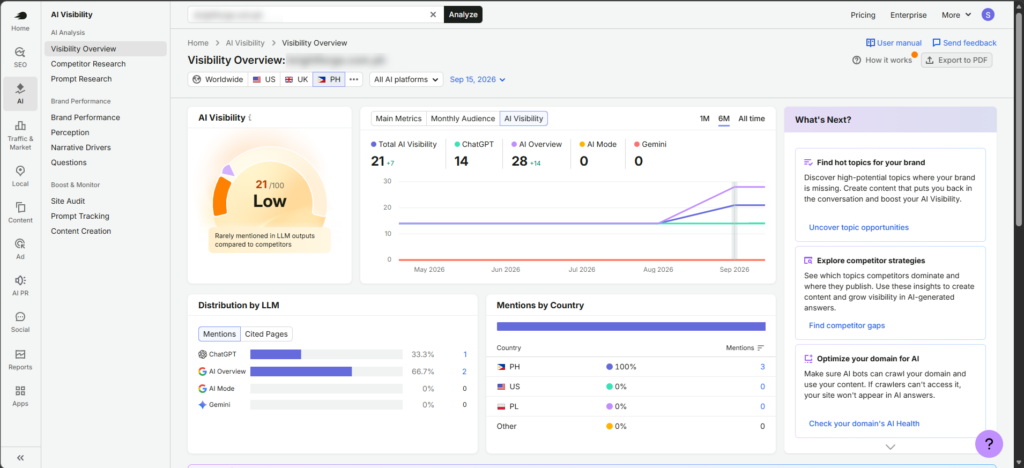
What surprised me when I first did this was how different the two pictures were. I had clients ranking in the top 3 organically who were mentioned in less than 10% of relevant AI answers. The gap was usually the same: their service pages listed deliverables but didn’t answer the evaluation questions — pricing models, timelines, reporting, what makes them different, who they’re best for. AI systems had nothing quotable to pull.
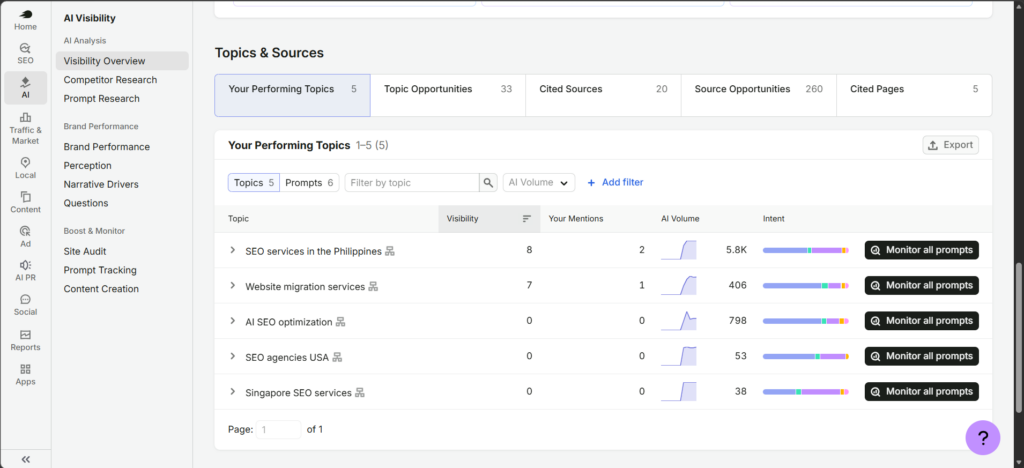
I now treat AI mention rate as a complementary KPI to rankings, not a replacement. Rankings tell me if I’m discoverable. Mentions tell me if I’m recommendable.
4. I Compare My AI Visibility with Competitors
I have always used competitor analysis to understand which websites are ranking for my target keywords.
With Semrush One, I can extend that analysis to AI search visibility.
Instead of looking only at competitor rankings, I can also examine which brands appear in AI-generated answers for relevant prompts.
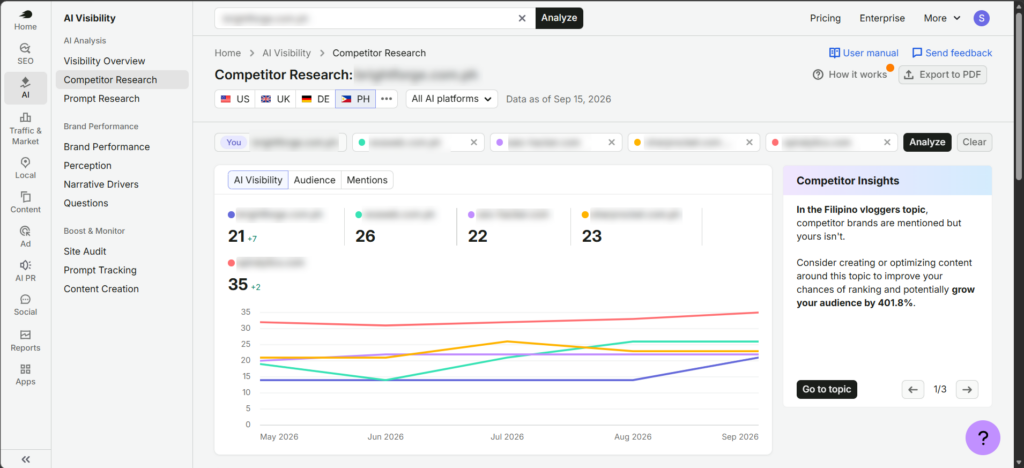
This helps me identify content gaps.
For example, if competitors are consistently mentioned when users ask about choosing an SEO agency, I can review the content supporting those recommendations. I can look for opportunities to improve my own service pages, explain my processes more clearly, and create useful content around the questions that matter to potential customers.
The goal is not to assume that one brand will always be recommended. It is to understand the information that AI systems may use when evaluating relevant options.

When I dig into why a competitor gets cited, it’s rarely because they have more backlinks. It’s usually because they have a specific asset I don’t:
- A detailed pricing / engagement models page
- A comparison page (“SEO vs. PPC for Philippine SMEs”)
- Original data (“We analyzed 50 Philippine ecommerce sites — here’s what we found”)
- A clear process page with timelines, deliverables, and FAQs
- Consistent third-party mentions and reviews that corroborate their claims
I document those assets prompt by prompt. That becomes my content gap backlog.
5. I Connect Prompt Research to Content Optimization
Once I identify valuable prompts, I need to turn those insights into content.
This is where Semrush One’s content optimization workflow can help.
Semrush provides tools for generating content briefs, identifying recommended keywords and subtopics, and optimizing content for both traditional search and AI visibility. Its AI Search Optimizer connects with other Semrush data sources to provide recommendations for improving content.
I can use this workflow to review an existing page and ask:
- Does the page answer the questions my audience is asking?
- Are the important topics covered clearly?
- Does the content explain the problem, solution, and relevant considerations?
- Are there supporting articles that can strengthen the topic?
- Is the page easy for users and search systems to understand?
For example, if I am optimizing an SEO services page, I may discover that users are asking about pricing, expected results, reporting, and the difference between SEO and paid advertising.
Those questions can guide the content improvements I make.

In practice, I’ve changed how I structure pages for AI citability. I still write for humans first, but I make sure each page has:
- A direct 40-60 word answer near the top that restates the prompt (“What SEO services should a Philippine business invest in…” → “If you want leads in 6-12 months, invest in…”)
- Short, self-contained FAQ blocks that can be quoted independently
- Comparison tables with clear criteria, not just feature lists
- Specific numbers where I can provide them (timelines, deliverables per month, reporting frequency)
- An expert take or process note that shows first-hand experience
That structure helps both traditional rankings and AI citations because it satisfies skimmers, search crawlers, and LLMs looking for extractable answers.
How I Would Build a Prompt Research Workflow
I would keep the workflow simple and connected to the SEO process I already use.
If you’re starting from scratch, you don’t need a separate “AI SEO team” or a 20-tab spreadsheet. You need a repeatable loop that starts with keywords and ends with better content. Here’s the loop I recommend, and the one I run inside Semrush One.
Step 1: Identify My Target Keywords
I begin with keyword research and group terms according to topic and intent.
I pull my current winners from Search Console and Position Tracking, run a Keyword Gap against two to three competitors, and cluster everything by page intent: agency evaluation, services, industry-specific (ecommerce, local, SaaS), and educational. I aim for 4-6 clusters max to start. If I try to track everything, I’ll track nothing well.
Step 2: Develop Relevant AI Prompts
I turn those keywords into conversational questions that reflect real user needs.
For each cluster, I write 10-15 prompts the way a real buyer would ask them in ChatGPT or Perplexity — including follow-ups. I also mine People Also Ask, Reddit threads, sales call transcripts, and Semrush One’s prompt suggestions for phrasing I missed. My rule: if a prompt sounds like something my sales team has actually heard on a discovery call, I keep it.
Step 3: Prioritize the Most Valuable Prompts
I focus on prompts that are relevant to my business, connected to my content strategy, and realistic opportunities for visibility.
I use the three-part score from earlier: business relevance, decision proximity, and content feasibility. A prompt has to score high on at least two to make my tracking list. I also tag each prompt to a page owner — service page, blog post, FAQ, or new page to create — so prioritization immediately turns into assignments.
Step 4: Track AI Visibility
I monitor how my brand appears in relevant AI-generated answers and compare the results with competitors.
I add my top 20-30 prompts to AI visibility tracking in Semrush One and check mention rate and share of voice monthly, not daily. AI answers fluctuate a lot. I’m looking for trends over 4-6 weeks: am I appearing more often, for more prompts, alongside stronger competitors? I also save the actual AI answers so I can see why a competitor was cited — what sentence, table, or stat got pulled.
Step 5: Improve Existing Content
I revisit the prompt list regularly because user behavior, AI responses, and search results continue to change.
I refresh my prompt list quarterly. I retire prompts that no longer drive business value, add new ones based on sales questions and Search Console queries, and re-run AI visibility to see if my content improvements moved the needle. AI search changes fast enough that a six-month-old prompt list is already stale.
Step 6: Review and Refresh
I revisit the prompt list regularly because user behavior, AI responses, and search results continue to change.
I refresh my prompt list quarterly. I retire prompts that no longer drive business value, add new ones based on sales questions and Search Console queries, and re-run AI visibility to see if my content improvements moved the needle. AI search changes fast enough that a six-month-old prompt list is already stale.
For a deeper explanation of how to choose prompts, I recommend reading How to Decide Which AI Search Prompts to Track.
What This Means for My SEO Strategy
The biggest change is that I no longer want to measure SEO performance only through rankings and traffic.
Those metrics still matter, but I also want to understand how my brand appears when people ask AI for information or recommendations.
This does not mean every keyword needs to become a prompt. Nor does it mean that every AI-generated answer will lead to a website visit.
Instead, I see prompt research as another layer of understanding search intent.
It helps me identify the questions behind the keywords, improve content relevance, and build a strategy that accounts for both traditional search and AI-generated answers.
I also need to be realistic about measurement. AI visibility is not the same as traffic or conversions. A brand mention can be valuable, but I still need to connect SEO and AI search insights with business outcomes.
For more context on this distinction, I recommend Semrush Review: Before You Upgrade, Read This.
The Metrics I Care About Now
I still report on rankings, organic traffic, and conversions — those pay the bills. But I now add three AI-specific metrics alongside them in Semrush One:
- AI mention rate: For my tracked prompts, how often am I mentioned at all?
- Prompt coverage: How many of my priority prompts have a dedicated page or section that directly answers them?
- Citation share vs. competitors: When AI answers my category prompts, who gets cited most often — me or them, and for which themes?
If rankings are flat but citation share is climbing, I know my content direction is right and traffic will usually follow as AI search blends more deeply into Google. If rankings are up but I have zero mentions, I know I have a relevance problem, not an authority problem.
The Content Changes That Actually Move AI Visibility
From what I’ve seen across service and ecommerce sites, the content that gets cited tends to share the same traits: it’s specific, structured, and verifiable.
I now prioritize comparison content (“SEO vs. Facebook Ads for lead generation in the Philippines”), criteria content (“how to choose…”, “what to look for…”, “red flags…”), and process transparency (what’s included, how reporting works, how long results take). I also invest more in original proof — mini case studies, pricing ranges, timelines, and FAQs taken from real sales objections — because AI systems heavily favor content that adds something beyond generic definitions.
I’ve also stopped burying the answer. My intros are shorter, my first H2 often is the direct answer, and my tables use plain-language headers that match prompt wording. That small structural change has made my pages easier to quote.
What I’ve Stopped Doing (Or Do Less Of)
I spend less time chasing single-keyword density and exact-match headings. I spend more time making sure a page fully resolves the next three questions a user would ask AI after the first answer.
I also stopped creating thin supporting articles for every keyword variation. Instead, I build fewer, deeper hubs where one strong service page plus two to three supporting guides cover an entire prompt cluster. That reduces cannibalization and gives AI a clear primary source to cite.
Key Takeaway
I do not see prompt research as the replacement for keyword research.
I see it as the next step in understanding how people search.
Keywords help me identify what users are interested in. Prompts help me understand how they ask questions, what they need, and when they are evaluating solutions.
With Semrush One, I can connect these insights to keyword research, AI visibility tracking, competitor analysis, and content optimization.
That gives me a more complete view of search performance.
As AI search continues to evolve, I believe the SEO strategies that will remain useful are the ones that focus on understanding users, creating helpful content, and measuring visibility across the different ways people discover information.
For me, the practical takeaway is simple: keep my keyword foundation, build a tracked prompt list on top of it, monitor whether I’m actually mentioned in AI answers, and close the gap with specific, quotable content. Rankings get me seen. Prompts get me chosen. I want to be visible for both.
