How We Use AI to Write Articles Without Producing AI Slop

AI has changed how I approach content writing. Research, outlines, keyword opportunities, and content reviews that used to take hours can now be done in minutes.
And that’s fantastic. But here’s the problem. Just because AI can write an article in seconds doesn’t mean it’s worth reading.
I’ve seen AI-generated articles with all the right headings and keywords, but nothing valuable to say. No original insights. No real experience. Just recycled information that you can find anywhere else.
That’s what the industry calls AI slop. And it’s exactly what I don’t want us producing at SEO Hacker, whether for our own websites or our clients’.
So how do we use AI without sacrificing the expertise, judgment, and originality that make content worth reading?
I’ll walk you through how we approach AI-assisted content writing, including how tools like Rankseer and Semrush One fit into our process.
What Is AI Slop, and Why Should I Avoid It?
AI slop is low-quality, AI-generated content that offers little originality, accuracy, or value to readers. It might look like a well-written article, but when you actually read it, there’s nothing particularly useful or new.
I see the biggest problem when teams treat AI as a content factory. They feed a list of keywords into a writing tool, generate dozens of articles, make a few minor edits, and publish everything without checking whether the content even deserves to exist in the first place.
The result? Websites filled with repetitive content, generic advice, and claims that nobody bothered to fact-check.
While Google can detect AI-generated content, its position is not that using AI automatically makes content unacceptable. What matters is whether the content is genuinely helpful or primarily created to manipulate search rankings
For me, the distinction is straightforward: I can use AI to speed up my workflow, but I cannot outsource responsibility for the final article.
Why AI Slop Creates Long-Term SEO Risks
Aside from the more obvious risks, like being flagged for spam, AI slop can create other long-term problems for your website’s search visibility.
First off, if you’re publishing dozens of AI-generated articles that say essentially the same thing, you’re not building a stronger website. You’re just adding more pages that compete with each other.
This can lead to keyword cannibalization, overlapping content, and a confusing website structure. Instead of helping Google understand your content, you’re making it harder to identify which pages are most relevant to a search.
And there’s another problem: trust. If someone visits your website and finds nothing but generic advice and recycled information, why would they trust your business? Why would they come back?
Google’s ranking systems aim to reward helpful, reliable, people-first content. While E-E-A-T isn’t a standalone ranking factor, demonstrating real experience, expertise, and credibility supports the kind of content Google wants to surface.
Why Human Editing Alone Is Not Enough
Running an AI-generated article through a human editor does not automatically make it valuable.
An editor can correct grammar, improve transitions, and remove awkward phrasing. However, if the article contains no original analysis, firsthand experience, meaningful examples, or reliable evidence, it remains a weak piece of content.
I need to ask a more important question: What does this article offer that another website cannot easily reproduce?
The answer might be a practical workflow, an expert’s perspective, an original observation, a useful comparison, or a detailed explanation of how something works in the real world.
If I cannot identify that added value, I need to improve the article before publishing it.
Step 1: I Start With Search Intent, Not an AI Writing Prompt
Before asking AI to write anything, I first figure out what the article needs to accomplish.
That means doing keyword research, analyzing competitors, and understanding what people actually want to know.
And there’s an important distinction here: keywords tell me what people search for. Search intent tells me why.
Take “AI SEO tools,” for example. Someone searching for this might want recommendations, pricing, comparisons, or a step-by-step guide. If my article doesn’t answer what they’re looking for, ranking for that keyword won’t mean much.
This is where I use Semrush One. It helps me research keywords, analyze competitors, and understand how brands appear in traditional and AI-powered search results.
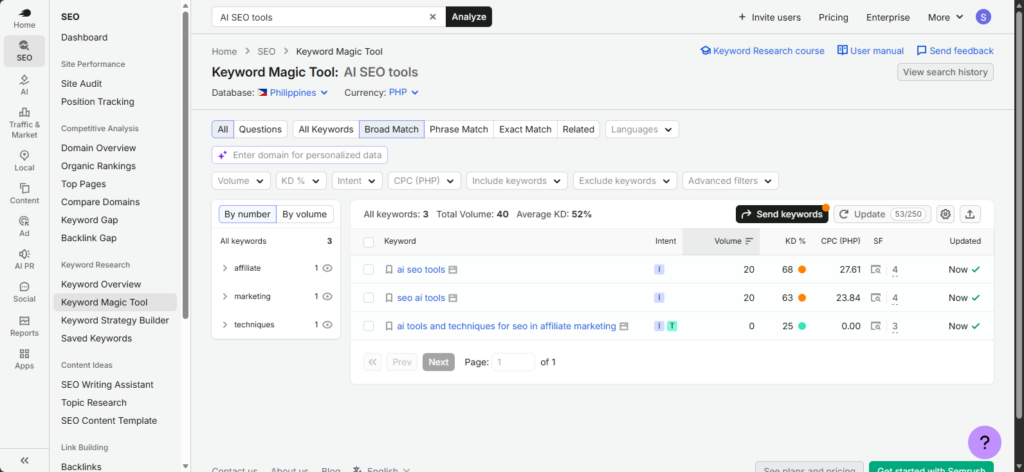
I also check whether the topic needs a new article or whether updating an existing one makes more sense. After all, there’s no point publishing five articles that answer essentially the same question.
Step 2: I Use AI to Organize Research, Not Invent Expertise
Once I know what the article needs to cover, I use AI to organize my research and create an outline.
It’s great for grouping related questions, identifying gaps, and suggesting how to structure an article. But here’s the catch: just because AI gives me an answer doesn’t mean it’s correct.
AI can confidently present outdated information, inaccurate statistics, or claims that sound convincing but have no reliable source behind them.
That’s why I still fact-check important claims, review the sources, and make sure the outline actually answers what readers are looking for.
This is especially important in SEO, where Google’s algorithms, best practices, and AI search experiences continue to change.
AI makes research faster. But it’s still my responsibility to make sure the information is accurate and worth publishing.
I also use tools like Rankseer to research keywords, analyze competitors, and identify content gaps. Its Brand Facts feature helps keep AI-generated content aligned with approved business information, while its Blog Builder supports fact-checking and brand voice settings.
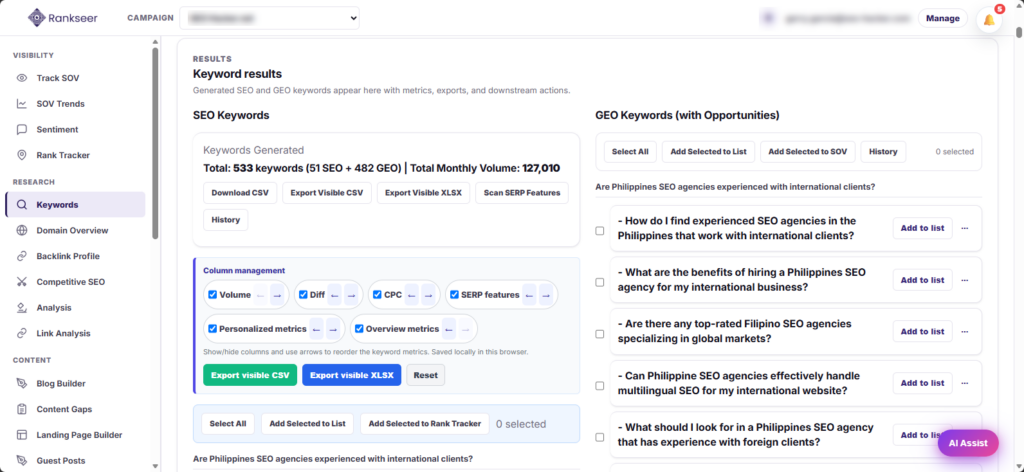
These tools help me give AI better direction instead of simply asking it to write about a broad topic and hoping for the best.
And that’s especially important in SEO (and AEO, and GEO), where algorithms, best practices, and AI search experiences are constantly changing.
Step 3: I Give AI a Clear Brief Before Drafting
One reason AI-generated content becomes repetitive is that the instructions are too vague.
If I ask an AI tool to write an article about SEO best practices, it will probably produce familiar advice about keywords, backlinks, technical SEO, and quality content. That information may be relevant, but it does not automatically create a compelling article.
I get better results when I provide a detailed content brief.
My brief should establish:
- Audience: Who is reading the article, and what do they already know?
- Search intent: What problem are they trying to solve?
- Primary objective: What should readers understand or be able to do afterward?
- Evidence: Which sources, internal data, or expert insights should inform the article?
- Unique perspective: What can we contribute beyond information that is already widely available?
- Editorial requirements: What tone, structure, terminology, and claims should the writer avoid?
I can then use AI to produce an initial draft that follows the brief.
The important distinction is that I am not asking AI to decide what our expertise should be. I am giving it enough context to help communicate that expertise more efficiently.
Step 4: I Edit for Originality, Accuracy, and Usefulness
This is where I make sure the article is actually worth reading.
I go through the draft and remove repetitive explanations, generic advice, and anything that doesn’t add value. If a claim sounds questionable, I fact-check it. If a recommendation is too vague, I add context or a practical example.
I also watch out for the usual signs of AI slop: repetitive sentences, unnecessary transitions, excessive bullet points, and paragraphs that sound impressive but don’t really say anything.
But beyond editing, I want every article to offer insight, not just information. And this is where my years of experience in the SEO industry come in.
Having worked with hundreds of clients across different industries, I’ve encountered problems that you won’t necessarily find answers to in a typical SEO guide. In fact, many of the articles I write come from real situations we’ve faced at SEO Hacker.
For example, we’ve encountered businesses that rank well on Google but aren’t getting enough qualified leads. That’s an opportunity to explain why rankings alone don’t guarantee conversions, and how search intent, website experience, and the sales process all play a role.
Or take AI visibility. A brand might appear in ChatGPT’s recommendations but see little to no increase in organic traffic. Having worked on both SEO and AEO, I can explain why that happens, what metrics are worth monitoring, and why AI mentions don’t always translate into website visits.
These are the kinds of examples and insights I bring into my articles. They’re based on problems we’ve worked through, strategies we’ve tested, and lessons we’ve learned along the way.
AI can help me organize those ideas and explain them more clearly. But it can’t replace the experience behind them.
Step 5: I Optimize for Search Without Forcing Keywords
Once I’m happy with the content, I make sure it’s optimized for both traditional search engines and AI-powered search.
And no, that doesn’t mean stuffing keywords into every other paragraph.
I check whether the article answers the main question clearly, covers related topics, and is easy to navigate. That includes using descriptive headings, adding relevant internal links, and making sure important information is easy to find.
These are good SEO practices to begin with. But they also support AEO and GEO, where clear answers, credible information, and well-structured content can improve your chances of appearing in AI-generated responses.
I use both Rankseer and Semrush One at this step, as they both have toolkits that help me identify search opportunities and monitor visibility across traditional and AI-powered search experiences.
One thing I pay particular attention to is how people phrase their questions when using AI.
Someone searching on Google might type “best SEO tools,” while someone using ChatGPT might ask, “What SEO tools would you recommend for a small business with a limited budget?”
Same general topic, but the second question gives us much more context about what the person actually needs. That’s why AI prompt research has become another important part of how I plan and optimize content.
Step 6: I Check Quality Before Publishing
Before publication, I treat the article as an asset that needs to pass quality checks, not simply as a completed writing task.
I check factual claims, links, headings, formatting, internal linking, and whether the article delivers on its title. I also look for unsupported claims, duplicated information, and sections that appear to have been added just to make the article longer.
Rankseer’s site audit and QA audit capabilities can support technical and content-quality checks, while its AI readability tools can help identify potential barriers to AI systems understanding a page.
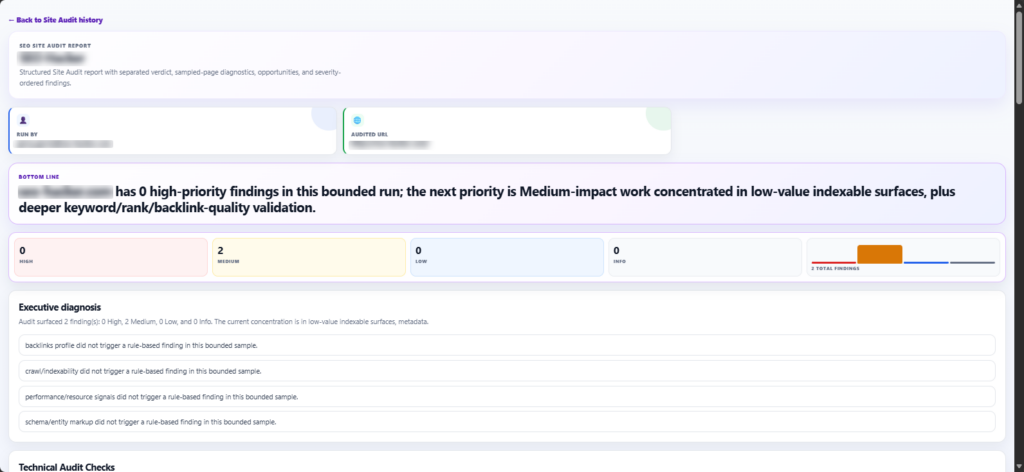
No AI search optimization tool, however, can replace an editor’s judgment. A page can pass automated checks and still be unoriginal, misleading, or unhelpful. That is why I treat tool recommendations as inputs to the review process rather than automatic approval to publish.
This is also consistent with Google’s approach to optimizing for generative AI search, where creating useful, trustworthy content remains more important than trying to game AI-powered search results.
Step 7: I Measure What Happens After Publication
Publishing an article isn’t the finish line. I still need to know whether it’s doing what I intended it to do.
For traditional SEO, I look at rankings, impressions, organic traffic, and conversions. These metrics tell me whether the article is reaching the right audience and contributing to business goals.
But with AI search becoming part of how people discover brands, I also look at AI Share of Voice, brand mentions, and citations in AI-generated answers. These are some of the key metrics I use when measuring AEO performance.
After all, someone might discover your business through ChatGPT without ever clicking a link to your website. This is where attribution in the age of AI answers becomes tricky. Your brand could be influencing purchasing decisions without that activity showing up in your traffic reports. Rankseer helps me track all of that – including metrics like AI Share of Voice, competitor visibility, and opportunities to improve our content.
The Future Is Not AI Content. It Is AI-Assisted Expertise
The debate should no longer focus on whether AI should be used in content creation.
For many organizations, AI is already embedded into day-to-day workflows. The real question is how to use it responsibly without sacrificing quality.
The organizations that gain the most value from AI will not necessarily be the ones generating the most content. They will be the ones using AI to scale research, accelerate production, improve workflows, and free up more time for expertise-driven work.
As AI tools become more accessible, originality, experience, and expert judgment become more valuable—not less.
Key Takeaway
I use AI to make content production more efficient, but I do not use it as a substitute for expertise. I use tools like Rankseer and Semrush One to make our content creation process faster, more organized, and easier to measure.
But no matter how good these tools become, they can’t replace the experience and expertise behind a genuinely useful article.
I still need to understand what readers are looking for, verify the information, share insights from years of actual SEO work, and make sure we’re publishing something worth reading.
Because at the end of the day, I don’t want us producing hundreds of articles just because AI makes it possible.
I’d rather publish something that genuinely helps people than a hundred articles that have nothing new to say.
And that’s how I use AI without producing AI slop.
