Agentic AI vs. Generative AI: What’s the Difference and Why SEOs Should Care
Artificial intelligence has evolved rapidly over the past few years. First, we learned how to use Generative AI to create content, summarize information, and speed up repetitive tasks. Now, a new term is becoming increasingly common in SEO and digital marketing conversations: Agentic AI.
At first glance, they might sound like the same thing. After all, both rely on large language models and both can produce useful outputs. But after spending time testing various AI tools and monitoring their impact on search visibility, I’ve realized that the difference between Generative AI and Agentic AI is much bigger than simply “one can do more.”
Understanding that distinction matters because it affects how we optimize websites, create content, automate workflows, and prepare for the future of AI-powered search. Google, OpenAI, Anthropic, and other companies continue investing heavily in AI experiences, fundamentally altering how information is retrieved and synthesized — a shift we explored in our guide on how generative AI search works.
As a result, SEO is gradually expanding from optimizing for search engines to optimizing for AI systems as well. Google itself has published guidance confirming that traditional SEO best practices remain foundational for visibility in generative AI search experiences, a point I broke down in more detail after reading Google’s own guide to optimizing for generative AI search.
TLDR: Generative AI vs. Agentic AI
- Generative AI creates outputs from prompts: it writes, summarizes, translates, brainstorms, and generates code based on user instructions.
- Agentic AI goes further by pursuing goals: it can plan multi-step tasks, retrieve and evaluate information, use tools, and refine its approach until an objective is completed.
- The key shift for SEOs is that AI systems are no longer just producing answers—they are increasingly deciding which sources are trustworthy enough to retrieve, cite, and act on. This changes SEO from optimizing for rankings alone to optimizing for inclusion in AI-driven answers and workflows.
- As a result, SEO is expanding beyond traditional visibility metrics. Websites now need to be structured and credible enough for AI systems to easily understand, verify, and confidently reuse their content.
Why This Comparison Matters for SEO
Before diving into the technical differences, it is critical to understand why this distinction is a turning point for SEOs. For years, we have viewed AI primarily as a tool for efficiency — a way to produce more content, faster. But we are moving from the era of AI-assisted content to the era of AI-driven action.
Generative AI changed how we create content. Agentic AI is changing how work gets done. This represents a fundamental shift in how users interact with search, moving from fragmented keyword queries to complex, conversational workflows where AI agents handle multi-step research tasks on behalf of the user.
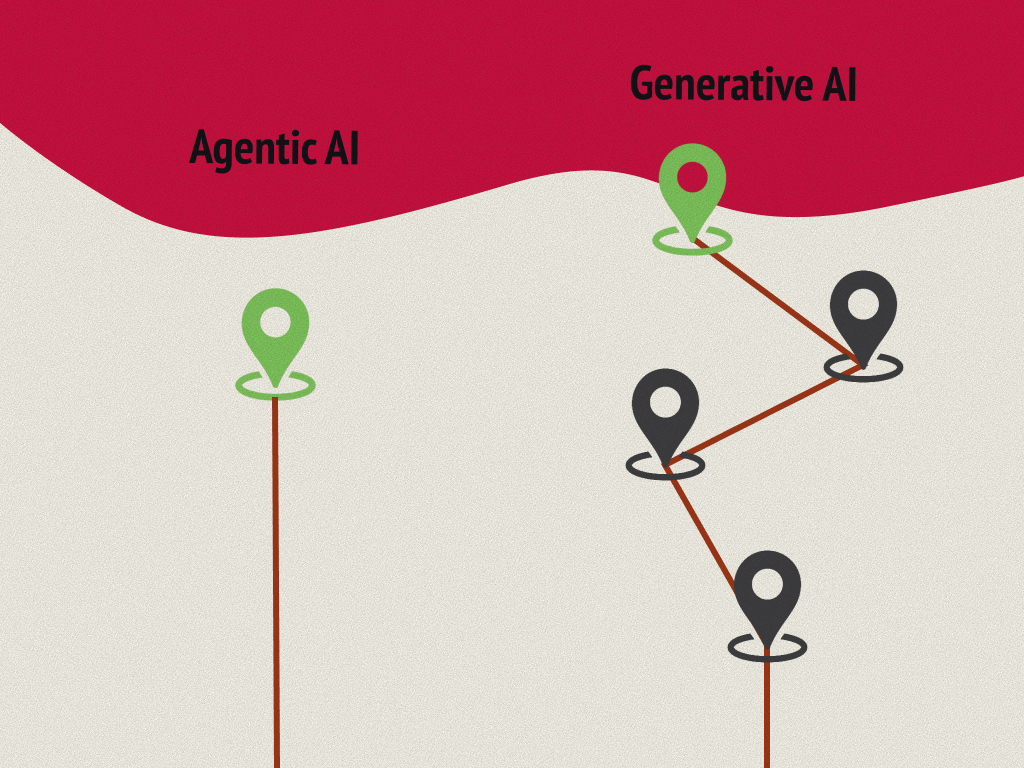
While Generative AI responds to a prompt with a static answer, Agentic AI pursues a goal through a series of iterative steps. It can research, compare multiple sources, use external tools, and self-correct until a goal is achieved. This shift has profound implications for the SEO landscape:
The Evolution of the User Journey
Traditionally, the user journey was Search → Click → Consume.
With Agentic AI, the journey becomes Request → Agent Executes → Outcome.
When an AI agent handles the “research” phase for a user, the traditional “click” becomes less frequent, but the “citation” becomes infinitely more valuable.
From Keyword Matching to Evidence Retrieval
Generative AI looks for patterns in data to predict the next word. Agentic AI, however, is designed to find evidence. It doesn’t just want to “sound” right; it needs to “be” right to complete a task. This shifts the SEO priority from optimizing for keywords to optimizing for retrievability and factual authority.
The Rise of AEO and GEO
As AI agents become the primary intermediaries between the web and the user, the focus shifts toward Answer Engine Optimization (AEO) and Generative Engine Optimization (GEO). We are no longer just optimizing for a ranking algorithm; we are optimizing for a reasoning engine that decides which sources are trustworthy enough to be used in a multi-step workflow.
Operational Transformation
For the practitioner, this is a leap in productivity. We are moving from manually running a technical audit or monitoring a competitor (reactive) to deploying agents that autonomously monitor, alert, and suggest fixes in real-time (proactive).
If you’ve already started tracking AI mentions using platforms like Rankseer or analyzing search performance with Semrush One, you’ll notice that AI systems are becoming more sophisticated in how they retrieve, evaluate, and cite content. They aren’t just summarizing your page; they are evaluating whether your page is the “best tool” to help them solve a user’s problem.
What is Generative AI?
Generative AI is built to create. At its core, it produces new outputs — whether text, images, audio, or code — based on the prompts it receives and the patterns it has learned from massive datasets. The workflow is simple: you provide an instruction, the AI generates a response, and then you decide what to do with it. Unlike autonomous systems, generative models don’t take initiative; they wait for direction and respond accordingly.
Examples include:
- Writing articles
- Creating product descriptions
- Generating code
- Summarizing documents
- Brainstorming ideas
- Translating languages
The workflow is usually straightforward:
Prompt → AI generates response → User decides what happens next
For example, if you ask it to “Write a 1,000-word article about technical SEO,” it writes the article. If you want revisions, fact-checking, or publishing, you have to request each step separately, because generative AI doesn’t take the next step on its own.
This makes generative AI incredibly versatile, and its strength lies in speed and scale — it lets teams produce content in seconds and adapt it to different formats. However, its effectiveness depends heavily on the quality of the prompt, and because it doesn’t verify facts or act independently, human oversight is essential.
For SEOs, this means generative AI is a powerful assistant for accelerating content creation and optimization, but it must be guided carefully to ensure accuracy, compliance with E-E-A-T standards, and alignment with search intent.
What is Agentic AI?
Agentic AI is designed not just to generate outputs but to accomplish objectives. Unlike generative systems that wait for instructions, agentic models operate more like autonomous digital assistants. They can break complex tasks into smaller steps, decide the best order of execution, retrieve additional information when needed, interact with software or APIs, evaluate results, and adjust their strategy until the objective is achieved.
Instead of asking:
“What should I do?”
An AI agent asks:
“How can I complete this goal?”
Rather than stopping after one response, Agentic AI can:
- Break large tasks into smaller tasks
- Decide which step comes next
- Retrieve additional information
- Use software or APIs
- Evaluate results
- Adjust its strategy
- Continue until the objective is completed
Think of the difference between hiring a copywriter and hiring a project manager. A copywriter produces content when asked, while a project manager coordinates multiple activities, adapts to challenges, and ensures the final outcome is delivered. Agentic AI represents that leap in capability: it moves beyond content creation into planning, reasoning, and execution.
For SEOs, this means an agentic system could autonomously run technical audits, monitor competitor movements, or even adjust internal linking structures without constant human prompting. It transforms AI from a reactive tool into a proactive collaborator, capable of managing workflows and driving results with minimal oversight.

Agentic AI vs. Generative AI
Although both Agentic AI and Generative AI are built on similar underlying language models, their roles in practice differ significantly — not because the engine is different, but because the vehicle built around it is.
Think of it this way: Generative AI is the engine. Agentic AI is the car with a driver, GPS, memory, and a toolkit in the trunk. Generative AI stops and waits for you after each response, which makes it best suited for creative work at a single point in time — drafting articles, writing product descriptions, or generating code snippets.
Agentic AI adds a reasoning layer on top of that same engine, entering a continuous loop: Perceive → Plan → Act → Evaluate. That loop lets it break a goal into steps, decide the best order of execution, use external tools on its own, retrieve new information when needed, evaluate whether its approach is working, and adjust its strategy until the workflow is complete.
In essence, Generative AI creates, while Agentic AI accomplishes.
Here are the 5 core differences that matter for SEO:
- Objective vs. Output: Generative AI optimizes for a good response to a single prompt. Agentic AI optimizes for a successful outcome to a multi-step goal.
- Interaction Model: Single-Turn vs. Multi-Turn: Generative AI requires frequent user instructions. If you want revisions, fact-checking, and publishing, you have to request each step separately. An Agentic AI system can operate autonomously across multiple turns. Give it an objective like “Audit this site for keyword cannibalization and propose an internal linking fix,” and it will continue working without constant prompting.
- Tool Use: Generative AI is typically confined to the chat window. It can tell you how to do something. Agentic AI can do it by connecting to tools and APIs — crawling a site, querying Search Console, analyzing SERPs, pulling data from a spreadsheet, or updating a CMS.
- Memory and Context: Generative AI has short-term memory. It remembers the current conversation but starts fresh each time. Agentic AI has persistent memory. It can remember previous steps, learn from errors in the same workflow, and build context over time, which allows it to handle complex, long-running tasks.
- How It Handles Failure: If a Generative AI response is inaccurate, it simply generates another inaccurate response unless you correct it. If an Agentic AI encounters an error — for example, a page fails to crawl or data is contradictory — it evaluates the result, re-plans, and tries a different approach.
At a Glance
Generative AI:
- Creates content: Produces text, images, or code on demand
- Responds to prompts: Waits for explicit instructions; reactive
- Usually performs one task at a time: Linear workflow (Prompt → Response)
- Requires frequent user instructions: Human is the project manager
- Best for creative assistance: Drafting, brainstorming, summarizing, translating
Agentic AI:
- Pursues goals: Focused on completing an objective, not just creating
- Plans multiple actions: Breaks complex goals into sequenced sub-tasks
- Uses tools autonomously: Can browse, crawl, call APIs, and use software
- Adapts based on new information: Evaluates results and changes strategy in real time
- Focuses on completing workflows: Continues until the objective is achieved
In other words:
Generative AI creates.
Agentic AI accomplishes.
What Does This Mean for SEO?
The rise of Agentic AI fundamentally changes how we think about optimization. Traditional SEO was built around helping search engines interpret webpages — ensuring they could crawl, index, and rank content effectively. For over two decades, that model worked because the relationship was straightforward: we optimized pages, search engines ranked them, and users clicked through to consume the content themselves.
But Agentic AI introduces a third layer to that relationship. Now, AI systems don’t just index your content — they use it. They retrieve specific facts, evaluate their reliability, synthesize them into answers, and present them to users, often without a traditional click ever taking place.
This shift is why Answer Engine Optimization (AEO) and Generative Engine Optimization (GEO) continues to gain traction: instead of focusing solely on rankings, SEOs must now consider how content is surfaced, interpreted, and cited in AI-driven search experiences. Where traditional SEO asked, “How do I rank for this keyword?”, AEO asks, “How do I become the source an AI agent trusts enough to cite?”
Now we also need AI systems to:
- Understand our expertise: It is no longer enough for a page to contain relevant keywords. Agentic AI systems evaluate topical depth, authorship signals, and the semantic relationships between your content and the broader knowledge landscape. If your website covers a topic comprehensively — with interconnected articles, expert contributors, and original insights — an agent is more likely to recognize you as an authority rather than a surface-level aggregator.
- Trust our information: Trust is earned through consistency, corroboration, and transparency. Agentic AI cross-references claims across multiple sources before deciding which one to cite. Content backed by original data, properly attributed expert quotes, and verifiable facts has a significant advantage over opinion-based or thinly sourced material. In practice, this means that E-E-A-T (Experience, Expertise, Authoritativeness, Trustworthiness) is no longer just a quality guideline — it is becoming the primary filter through which AI agents select their sources.
- Retrieve the correct page: Retrievability is emerging as one of the most important technical SEO considerations in the agentic era. An AI agent doesn’t browse your site the way a human does; it queries your content looking for the most precise, relevant answer to a specific sub-task. If your site architecture is disorganized, if critical information is buried in PDFs or rendered only through JavaScript, or if your pages lack structured data that explicitly defines what each piece of content is about, the agent may retrieve the wrong page — or skip your site entirely in favor of a competitor whose content is easier to parse.
- Confidently cite it: Citation confidence is the final hurdle. Even if an agent finds your content and deems it relevant, it must still decide whether your source is reliable enough to present to the user. This decision is influenced by a combination of signals: domain authority, content freshness, factual accuracy, the presence of structured data, and how well your content aligns with what the agent has found across other trusted sources. Being cited by an AI agent is the new equivalent of earning a featured snippet — except the stakes are higher, because the agent’s own reputation depends on the quality of the sources it recommends.
In short, Agentic AI pushes SEO beyond rankings into a new era where credibility, retrievability, and trustworthiness are just as critical as technical optimization. The SEO professional’s role is expanding from “helping search engines find and rank our pages” to “ensuring AI systems understand, trust, and confidently recommend our brand.”
Those who adapt to this dual reality — maintaining traditional SEO excellence while building for AI retrievability — will be the ones who thrive as agentic experiences become the norm rather than the exception.
Content Quality Becomes Even More Important
A common misconception is that optimizing for AI means writing content specifically “for AI.” In reality, Google’s recent guidance emphasizes the opposite: helpful, original, and experience-driven content remains the foundation of visibility, even in AI-powered search experiences.
This principle becomes even more critical when we consider the shift from Generative AI to Agentic AI. Generative AI primarily synthesizes existing information into coherent answers. Agentic AI, however, goes a step further — it actively searches for, evaluates, and selects sources to accomplish a goal. This means AI systems are no longer just summarizing content; they are making judgment calls about which sources are trustworthy enough to rely on when completing tasks.
As a result, the fundamentals of high-quality content have not changed, but their importance has increased:
- Original research: First-party data and unique insights give AI systems something they cannot easily replicate or find elsewhere.
- Expert opinions: Clear attribution to subject matter experts helps AI agents assess authority and credibility.
- First-hand experience: Demonstrating real-world application builds the kind of trust signals that agentic systems prioritize when choosing between multiple sources.
- Clear page structure: Logical organization makes it easier for AI to understand relationships between ideas.
- Strong internal linking: Helps AI map topical authority and follow the flow of expertise across your site.
- Comprehensive topical coverage: Thoroughly addressing a subject reduces the likelihood that an AI agent will need to look elsewhere to complete its objective.
While these fundamentals remain essential, their execution now requires greater precision for machine readability. Specifically, structuring content for AI extraction means moving beyond traditional headers and bullet points. It involves implementing schema markup, defining entity-based relationships, and creating semantic hierarchies that allow agentic systems to verify facts against your expertise. When done correctly, this makes it significantly easier for AI agents to confidently cite your brand as a reliable source when executing multi-step workflows.
In short, content quality is no longer just about ranking — it’s about becoming the source an AI agent chooses to trust when making decisions on behalf of users.

Measuring Success in an AI-First World
One of the biggest challenges SEOs face today is figuring out how to measure visibility in AI-driven search. Traditional metrics like keyword rankings, organic traffic, and click-through rates are still valuable, but they no longer tell the full story.
AI systems increasingly act as intermediaries, retrieving and summarizing information before users even click through to a site. This means that impressions, citations, and mentions inside AI experiences are becoming just as important as rankings on the SERP.
Google has already started adapting to this shift by rolling out dedicated Search Generative AI performance reports in Search Console. These reports separate visibility inside AI experiences — such as AI Overviews and AI Mode — from traditional search reporting. While the current focus is on impressions rather than clicks, this represents a critical step toward understanding how often your content is surfaced in AI-powered results.
Over time, these metrics will help SEOs evaluate not just whether their pages are ranking, but whether their expertise is being recognized and cited by Google’s AI systems.
Outside of Google’s ecosystem, specialized platforms are emerging to fill the gap. Tools like Rankseer provide visibility into brand mentions and citations across multiple AI platforms, offering marketers a broader perspective on how frequently their content appears in AI-generated answers.
Meanwhile, established SEO tools such as Semrush One continue to deliver competitive insights rooted in traditional SEO, helping teams balance both worlds. Together, these tools highlight a new reality: measuring success in an AI-first world requires tracking not only rankings and traffic, but also how often your content is retrieved, trusted, and referenced by AI systems.
Can You Optimize Your Website for Generative AI Search?
Yes, and the mechanics are closer to traditional SEO than most people expect. Generative AI search (also known GEO) still depends on crawling, indexing, and understanding your content before any of it can be pulled into a synthesized answer, so the same technical foundation — crawlability, clean site architecture, structured data, and genuinely helpful content — still determines whether you show up at all.
What changes is how that content gets used once it’s found: instead of ranking one page and sending a click, the AI system fans a single query out into several related sub-questions and pulls fragments from multiple sources to build one answer.
In practice, that means answering the core question clearly near the top of the page, covering the related sub-questions a reader would naturally ask next, and using structured data that makes the relationships between your ideas easy to parse.
I go deeper into query fan-out and how to structure pages around it in how generative AI search works, and I’ve broken down Google’s own recommendations in their guide to optimizing for generative AI search – both are must-reads if you want to get started on GEO.
Can You Optimize Your Website for Agentic AI?
Yes, though the target shifts from optimizing a page to optimizing your brand as a whole entity. Agentic AI doesn’t browse a site the way a person does; it queries your content looking for a precise answer to a sub-task, cross-references what it finds against other sources, and decides whether your brand is credible enough to cite or act on.
That makes retrievability (can the agent actually find and parse the right page), entity clarity (is your brand described consistently across your site, directories, and third-party sources), and trust signals (author credentials, original data, citations to primary sources) matter more than they did for traditional rankings alone.
I cover how to structure content so agentic systems can verify and extract it in structuring content for AI extraction, and the entity and trust signals that influence whether AI systems recommend your brand at all in how LLMs choose which brands to recommend. Though not specifically written for AI agents, the systems behind the two are similar enough that it’s worth reading.
Key Takeaway
Generative AI and Agentic AI are closely related, but they serve different purposes.
Generative AI excels at creating content based on prompts, making it an excellent assistant for writing, coding, brainstorming, and summarization. Agentic AI goes a step further by planning, reasoning, using tools, and completing multi-step objectives with minimal human intervention.
For SEO professionals, this evolution reinforces something we’ve always known: high-quality, authoritative, well-structured content wins over shortcuts. As AI-powered search continues to mature, success won’t come from chasing algorithms — it will come from building trustworthy resources that both people and AI systems can confidently rely on.
Whether you’re monitoring AI visibility through Rankseer, conducting competitive research with Semrush One, or refining your broader SEO strategy, understanding the distinction between Agentic AI and Generative AI will help you prepare for the next stage of search.
