Google Core Updates 2026: A Recovery Playbook for January, March, May, and June Updates
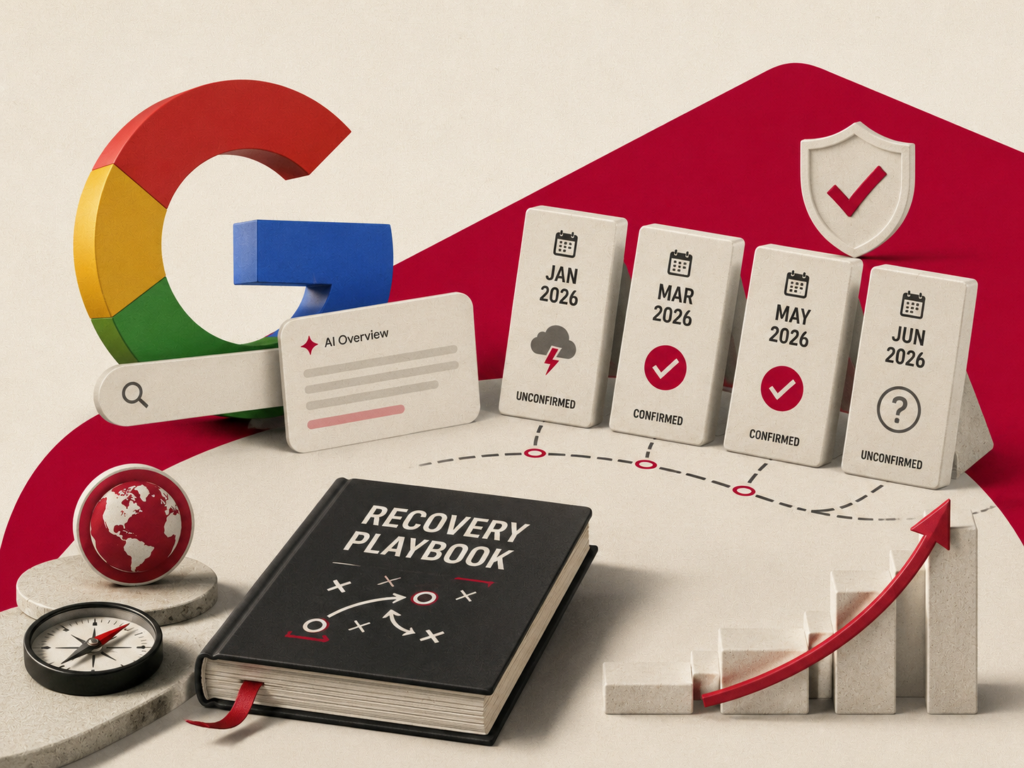
Seven months into 2026, and Google Search still hasn’t settled down. If your traffic chart looks like a seismograph, you’re not imagining it — between January’s quiet crackdown, two officially confirmed core updates, and a strange week of community panic in June that the tracking tools barely registered, this has been one of the most unpredictable stretches in recent Search history.
Layer on top of that the fact that AI Overviews, AI Mode, and now autonomous search agents are quietly rewriting what “ranking well” even means, and most sites are dealing with two compounding problems at once: getting hit by an update, and losing clicks even when they aren’t.
Here’s what actually happened, how each update changed what wins, and what to do about both problems.
- 2 officially confirmed broad core updates since January (March and May).
- 12 days — how fast the May 2026 core update rolled out, Google’s quickest in years.
- 30–50% — typical traffic loss reported by sites caught in January’s unconfirmed crackdown.
- 68% — share of Google searches in 2026 that end without any click at all.
Google Core Update Timeline 2026: January, March, May, and June
It helps to separate what actually happened this year, because each wave targeted a different slice of your site, and the recovery work is different for each one.
January (unconfirmed)
Around January 21, search visibility cratered for a specific type of page: self-promotional “best of” listicles, where a company ranks its own product or service at the top of its own roundup. There were documented visibility drops in the 30–50% range concentrated in SaaS and B2B blog content, while the same sites’ core commercial pages stayed largely stable.
The ranking effect from this one was narrow and surgical — it hit blog and resource sections specifically, not homepages or product pages. It was similar to a review-system adjustment. Google confirmed nothing — no core update, no spam update, no reviews update — which is itself a sign of how this year has gone.
February
A Discover-only core update rolled out and wrapped by the end of the month. This one only touches the Discover feed, not regular search rankings, so don’t chase it if your traffic drop showed up in Search Console’s “Web” tab rather than “Discover.”
March (confirmed)
The first officially labeled broad core update of the year, announced in the early morning and given roughly three weeks to complete. Analysis and forum posts show a recurring pattern among the sites it hit hardest: pages that read like they’d been written for AI search and answer engines rather than for people, with rankings dropping across many queries on those specific articles even as the rest of the site held up.
That’s a meaningfully different signal than a generic “content quality” downgrade — it suggests Google’s systems are getting better at spotting content engineered for extraction rather than for reading.
May (confirmed)
Bigger than March’s algorithm update, and it was rolled out a lot faster — Google had it pushed in just twelve days, with major volatility spikes hitting on three separate occasions during the rollout, including one final surge on the very last day before Google called it done. For this core update, we found that the steepest losses weren’t spread evenly across the site — they concentrated in Top Stories and other news-style search features, while standard organic results moved less.
Analysts also found that many of the sites hammered back in January’s unconfirmed update still hadn’t recovered by the time May wrapped — the same content, the same patterns, the same losses, just confirmed this time as part of an official update.
June (still unconfirmed)
A full week of unusually intense SEO community chatter about ranking swings — forum threads describing traffic crashing and partially bouncing back within 24 to 48 hours — while the major third-party volatility trackers stayed mostly flat.
That mismatch between what site owners feel and what the tools measure is becoming a pattern in itself, and it’s worth understanding before you go looking for a fix.
How AI Overviews and AI Mode Are Changing Search Discovery in 2026
Even a perfect recovery from every core update above won’t fix a problem that has nothing to do with rankings: fewer searches send a click anywhere at all.
According to a Similarweb and SparkToro study published in June 2026, 68.01% of US Google searches in the first four months of the year ended without a click — up from 60.45% in 2024. Of the roughly 32% of searches that do produce a click, about two-thirds go to the open web, a little over a quarter stay inside Google’s own properties (AI Mode, Maps, YouTube, Images), and the rest go to paid ads. Run the math and only about 276 clicks reach the open web for every 1,000 searches.
The mechanism is straightforward. AI Overviews now appear across a meaningful share of all Google searches, answering the question directly on the results page before a single link gets a chance to earn a click.
Estimates of exactly how much this cuts organic click-through rate vary by study and by query type — informational queries tend to lose more than commercial ones — but the direction is consistent everywhere: the higher up the page an AI-generated answer sits, the less reason there is to scroll down to position one.
The newer wrinkle is AI Mode itself, which Google said had passed a billion monthly users earlier in 2026, with usage more than doubling every quarter. And just this month, Google began rolling out “Information agents” inside AI Mode for paying AI Ultra subscribers — a feature that lets a person describe what they’re looking for once (an apartment with specific requirements, a sneaker drop from a favorite athlete) and have an agent continuously scan the web on their behalf, surfacing updates without the person ever running a new search.
That’s a genuine shift in the discovery stage: instead of a human searching, clicking, and comparing, an agent does the searching and the comparing, and only the result reaches the person. If your content isn’t structured cleanly enough for that agent to read, extract, and trust, you don’t just lose a click — you may never enter the comparison set at all. That’s a principle I cover in-depth in my previous AI search optimization series.
How to Diagnose Which Google Update Hit Your Site
Before changing anything on your site, figure out what you’re actually dealing with.
- Match the date, not the headline. Pull your exact drop date from Search Console and compare it against the windows above — January 21, March 27 through April 8, May 21 through June 2, or the June 8–12 chatter window. A drop that lands cleanly in one of those windows points you toward a cause; a drop that doesn’t match any of them might be something else entirely (a technical issue, a seasonal shift, a competitor’s launch).
- Look at what kind of content dropped. If it’s specifically your blog or resource section — especially listicles, “best of” roundups, or comparison posts where your own product takes the top spot — that lines up with the pattern Google has been targeting since January.
- Check whether the affected pages read like they were written for an AI summarizer. Heavily templated, keyword-stuffed explainer content with no real point of view is exactly what the March update appears to have targeted. If your losses are concentrated there, the fix is editorial, not technical.
- Separate news-style content from the rest of the site. If you publish anything resembling Top Stories-eligible news content, check that segment’s performance on its own — May’s impact was uneven across page types, and a site-wide average can hide a feature-specific collapse.
- Check whether rankings actually moved, or just clicks did. If your positions held steady but traffic still fell, an AI Overview or AI Mode result sitting above you in the SERP may be the real explanation, not a ranking penalty. Compare impressions against clicks in Search Console — flat impressions with falling clicks is a discovery-stage problem, not a ranking problem.
- Cross-reference the chatter against the tools. If you’re seeing volatility but Semrush Sensor, Mozcast, AccuRanker, or similar trackers show nothing unusual, you’re likely in “unconfirmed update” territory rather than a clearly documented core update — which changes how patient you need to be before reacting.
Google Core Update Recovery Checklist
These are organized by what they fix, because a single generic list tends to bury the items that matter most for your specific situation.
Content and quality actions (directly tied to January, March, and May):
- Audit any self-promotional listicle or comparison content where your own product or service is ranked first. This has been the single most consistent loser pattern since January.
- Re-read your highest-traffic explainer and “what is X” pages and ask honestly whether they were written to inform a person or to rank for a keyword. The March update’s pattern suggests Google’s systems can now tell the difference.
- If you publish news or trending content, audit your Top Stories performance separately from your core organic numbers — don’t assume a stable homepage means a stable news section.
- Look for the “Mt. AI” pattern in your own content history — a section that surged after a wave of AI-assisted publishing and then crashed. That’s a signal to slow production and raise the editorial bar rather than publish your way out of it.
- Add original data, firsthand testing notes, or a named author with real credentials to comparison and roundup content. Independent methodology is what separates a legitimate “best of” post from the self-referential kind that’s been losing visibility all year.
- Consolidate thin or near-duplicate pages into fewer, stronger ones rather than letting a long tail of weak content dilute the site’s overall quality signal.
Technical and structural actions:
- Check Search Console’s Discover report separately from Web performance. A Discover-specific drop needs a different fix than a core-update-driven drop in regular search.
- Fix outstanding Core Web Vitals issues — page experience signals compound over multiple core updates rather than resetting each time.
- Make sure your most important pages are easy for Google to crawl, render, and understand without depending on heavy client-side JavaScript, since that affects both classic indexing and how cleanly an AI system can extract your content.
- Review your backlink profile for anything that looks like network participation — mass guest posting, expired-domain links, link exchanges. These keep getting devalued faster with every update.
AI visibility and discovery-stage actions (new for 2026):
- Structure key pages so the most important facts and direct answers appear clearly near the top, in plain language — this is what gets pulled into AI Overviews and cited by AI Mode and agents.
- Implement and keep current the structured data (schema.org) that applies to your content type, since both Information agents and AI Overviews lean on machine-readable signals to verify facts quickly.
- Start tracking your AI citation footprint, sometimes called “Share of Model” — periodically check whether your brand or content actually gets surfaced inside AI Overviews, AI Mode, and tools like ChatGPT or Perplexity for your core topics.
- Track branded search volume in Search Console as a standing KPI, not just organic sessions. Brand search holds up even when generic clicks decline, and it’s a much harder signal for an AI summary to intercept.
- For e-commerce or local listings, keep price, availability, and product data clean and frequently updated — agentic features like Information agents are explicitly built to monitor for exactly this kind of change.
- Diversify how people reach you. Email, communities, and direct traffic don’t depend on winning a click inside an increasingly crowded results page.
What Not to Do After a Google Core Update
- Don’t gut your content library overnight. Wholesale deletion after a drop tends to hurt site-wide authority more than it helps; improving or consolidating thin pages is almost always the better move than deleting them.
- Don’t treat an unconfirmed update like a confirmed one. If the tracking tools aren’t showing meaningful movement, a single forum thread isn’t enough to justify rebuilding a content strategy around it. Watch for a pattern across multiple sources first.
- Don’t confuse an algorithmic hit with a manual action. If you’ve actually received a manual action notice in Search Console, that’s a separate process entirely, requiring a direct fix and a reconsideration request — no amount of general content cleanup will resolve a manual action on its own.
- Don’t confuse a ranking problem with a discovery problem. Rewriting content to chase a core update won’t recover traffic that an AI Overview is simply intercepting before the click happens. Diagnose which one you have before you spend weeks fixing the wrong thing.
- Don’t chase a single fix for a multi-factor drop. Between content quality, AI Overview displacement, and link profile issues, most 2026 traffic drops have more than one contributing cause. A narrow fix usually produces a partial recovery at best.
The Future of Google Core Updates and AI Search
If 2026 has a throughline, it’s this: Google is increasingly comfortable making consequential changes without telling anyone, and the gap between “official update calendar” and “what’s actually happening to rankings” is wider than it’s been in years. The unconfirmed January crackdown turned out to foreshadow exactly the kind of content the confirmed May update went after months later. There’s a reasonable chance June’s unconfirmed volatility is doing the same thing right now, quietly setting up whatever the next labeled core update targets.
At the same time, the destination for a “click” is split in two. A shrinking share of searches still send someone to the open web in the traditional sense, while a growing share get resolved by an AI Overview, handled inside AI Mode, or — starting this year — delegated entirely to an agent that searches on a person’s behalf and only surfaces the result. Ranking well is necessary but no longer sufficient. Being structured and credible enough that an AI system chooses to cite you is becoming its own discipline, running in parallel with classic SEO rather than replacing it.
The practical takeaway isn’t to chase every unconfirmed signal — it’s to keep doing the things that have held up across every wave so far, while adding the newer discovery-stage habits to your routine: content with a real point of view, pages built for the person reading them rather than for the algorithm scoring them, a backlink profile that wouldn’t embarrass you if someone actually looked at it, and a growing awareness of whether AI systems are citing you at all. That combination has been the most reliable form of update insurance all year, confirmed or not.
Frequently Asked Questions About Recovering From a Google Core Update
How many Google core updates have there been in 2026 so far?
As of July, only two officially confirmed broad core updates — March and May — plus a Discover-only core update in February and two unconfirmed waves of volatility, in January and again in June.
How long should I wait before reacting to a traffic drop?
At minimum, wait until a rollout is confirmed complete, since several 2026 updates produced fresh volatility spikes right up until the final day. For unconfirmed volatility, wait for a consistent pattern across both community reports and tracking tools before making major changes.
Why is my traffic down even though my rankings look fine?
This is increasingly common in 2026 and usually points to AI Overviews or AI Mode resolving the query before a click happens, rather than an actual ranking loss. Check impressions against clicks in Search Console — stable impressions with falling clicks is a strong sign the issue is discovery-stage, not ranking-stage.
Does this affect AI Overviews and AI Mode too?
Yes. Analysts tracking the January crackdown found that losses in regular organic visibility often carried over into reduced presence in AI Overviews, AI Mode, and even third-party AI tools that pull from search data — reinforcing that classic SEO and AI-search visibility aren’t really separate disciplines anymore.
What’s the fastest way to check if a drop matches a known Google update?
Pull the exact date of your traffic change from Search Console and compare it against the confirmed windows (March 27–April 8, May 21–June 2) or the unconfirmed chatter windows (January 21, June 8–12), then cross-check with a third-party volatility tracker to see whether the broader industry was moving too.
