How to Optimize Landing Pages for AEO: Structure, Schema, and AI Visibility
Your landing page might be converting well. Good copy. Clean design. Strong CTA. But here’s a question worth asking: Can an AI actually understand it?
Because in 2026, that matters more than you think. AI-powered search engines like ChatGPT, Perplexity, and Google AI Mode are now the first stop for millions of buyers. They don’t send users to a list of links. They synthesize information and deliver one direct answer. And if your landing page isn’t structured for that, you’re invisible before the conversation even starts.
That’s the core idea behind Answer Engine Optimization (AEO), and it’s changing how high-performing landing pages are built. If you want to understand where this is all heading, our breakdown of AI search trends in 2026 is a good place to start.
Why Traditional Landing Pages Underperform in AI Search
Traditional landing pages are designed with one audience in mind: humans. And they’re good at it. Emotive headlines, social proof, benefit-driven copy, bold CTAs. These are all proven persuasion tools.
But AI systems don’t feel persuaded. They scan for structure.
When a tool like ChatGPT or Google’s AI Mode crawls your landing page, it’s looking for clear, extractable information: definitions, use cases, direct answers. If your page opens with a clever tagline and buries the actual “what” three scrolls deep, the AI moves on to a competitor whose page made it easier.
Part of what drives this behavior is how AI systems interpret search intent. Understanding intent-to-answer mapping can help you see exactly how AI engines match user queries to the content they choose to surface.
There’s also a technical dimension to this. Many landing pages rely on JavaScript to load content dynamically. The problem is that a lot of AI crawlers can’t reliably execute JavaScript. If your key messaging only appears after a JS render, it might as well not exist to those systems.
The result? A page that converts humans who find it, but gets skipped entirely by the AI systems that decide whether those humans find it in the first place.
What Makes a Landing Page AEO-Ready?
Getting your landing page AEO-ready doesn’t mean scrapping what works. It means layering in the structure that AI systems need to read, extract, and cite your content. Here’s what that looks like in practice.
1. Clear Entity Definitions and Use Cases
AI answer engines work by identifying entities: the “who,” “what,” and “for whom” of a piece of content. Your landing page needs to answer these questions explicitly, near the top of the page.
Don’t assume the AI (or a first-time visitor) will figure out what your product is from context. State it directly:
- What is it? A one-sentence definition of your product or service.
- Who is it for? A specific audience or use case.
- What problem does it solve? A concrete outcome, not a vague benefit.
This kind of entity clarity is what allows AI systems to accurately recommend your page when a user asks something like “what’s the best tool for X.”
2. Structured Data and Scannable Formats
If clear language is the signal, structured data is the amplifier. Adding schema markup, specifically FAQ schema, Product schema, or Organization schema, gives AI crawlers a roadmap to your most important content.
Beyond schema, the visual format of your page matters too. AI systems parse content in chunks, not as a whole. Each section should be self-contained and scannable. That means:
- Using proper H2 and H3 tags to signal topic hierarchy
- Breaking down processes into numbered steps
- Using comparison tables when evaluating options
- Including a dedicated FAQ section that mirrors real user questions
Think of each section as something that could be lifted out of context and still make complete sense on its own.
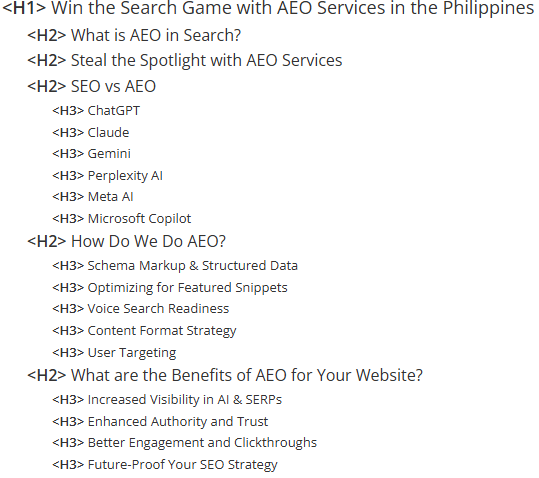
Here’s an example of how we structure a landing page with proper heading hierarchy — each H2 and H3 signals a clear topic for both readers and AI crawlers.
3. Direct, Quotable Answers for AI Summarization
Here’s a pattern worth testing on your own page: read the opening sentence of each section out loud. Does it immediately answer the implied question of that section heading?
If the answer is “kind of,” that’s a problem. AI systems extract the first one to two sentences of a section to determine relevance. If those sentences are setup or context-setting rather than direct answers, the engine moves on.
A simple reframe: instead of opening a section with “Many businesses today struggle with X, which is why…”, try “X is solved by [your approach] because…” Lead with the answer, support it with context. This is also closely tied to how query fan-out works in AI search, where a single user query branches into multiple sub-queries that your content needs to address.
AEO vs. SEO: How They Work Together
Before going further, it’s worth clearing up a common misconception: AEO doesn’t replace SEO. It extends it. If you’re wondering whether the investment is worth the effort, our take on whether AI SEO is worth it walks through the practical case.
Dimension Traditional SEO AEO Primary goal Rank in search results Get cited in AI answers Success metric Traffic and click-through rate Brand mentions and citations Content focus Keyword relevance Structural clarity and authority Technical priority Crawlability, page speed Server-side rendering, schema markup Audience Human searchers AI systems + human searchers
Both approaches share the same foundation: well-structured, authoritative, fast-loading content. The difference is in what you optimize for on top of that foundation.
Balancing Conversion and Extractability
This is where it gets interesting, and honestly where most guides stop short.
The instinct is to think of AEO and conversion optimization as competing priorities. Make it too structured for AI and it feels clinical to humans. Make it too persuasive for humans and the AI can’t parse it.
But the best-performing landing pages in 2026 do both. Here’s how they think about it:
For humans: persuasion and UX
- Emotional hooks in the headline
- Social proof (testimonials, case studies, logos)
- Clear visual hierarchy that guides the eye
- A single, obvious CTA
- Server-side rendered content (not JavaScript-dependent)
- Semantic HTML5 tags (<main>, <section>, <article>)
- JSON-LD schema markup for FAQs, products, or organizations
- Direct, definition-first copy at the start of each section
The secret is that these goals are more compatible than they seem. A landing page that opens with a clear, direct statement of what it does, before moving into storytelling and emotional copy, serves both audiences well. Humans get oriented faster. AI gets the entity definition it needs.
It’s also worth thinking beyond text. Building a multimodal content strategy ensures your page holds up across the different ways AI systems process and present information, including voice, visual, and structured formats.
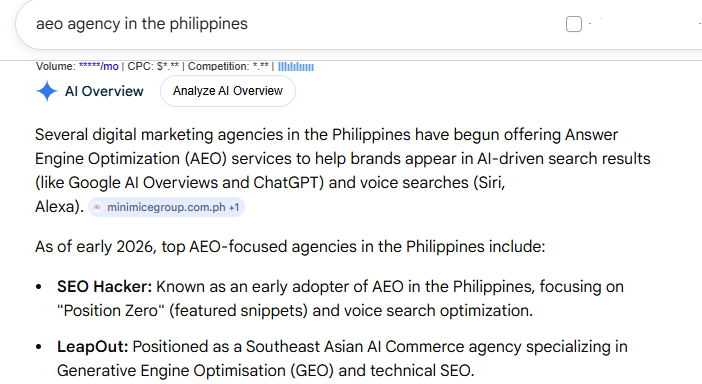
This is what AEO-ready structure can get you — SEO Hacker appearing in Google’s AI Overview for “AEO agency in the Philippines,” cited alongside top agencies in the region.
If you want your landing page to be “extractable,” you need to control the order in which AI crawlers and users encounter information.
Recommended structure:
- H1: Clear promise + primary entity (“AEO Landing Page Optimization for [Audience]”)
- 1–2 sentence definition block: What it is + who it’s for + what it does
- Use-case bullets (3–5): “Best for…” scenarios that mirror real prompts
- Proof layer: logos, testimonial snippet, 1 mini-case result
- Primary CTA
- How it works: 3–5 steps with tight headings
- Features / inclusions: grouped by outcome (visibility, citations, conversion)
- Comparison block: “AEO-ready vs traditional landing page”
- FAQ (AEO-targeted): 6–10 Q&As
- Trust / About: authorship, credentials, about the org
- Footer: contact, legal, citations/references if applicable
This layout helps humans decide fast, and helps AI identify the “what” immediately.
How to Write Sections AI Will Actually Use
AEO landing page optimization is really a writing strategy: you’re creating “answer modules” that map to common query shapes.
Common AI query shapes to map:
- “What is [service]?”
- “Best [service] for [industry]”
- “How does [service] work?”
- “Is [service] worth it?”
- “[service] vs [alternative]”
- “How long does it take to see results?”
- “How much does it cost?”
- “What should I look for in a provider?”
How to implement:
- Turn each query shape into an H2
- Start with a direct 1–2 sentence answer
- Follow with supporting bullets
- Add one proof element (mini-case, stat, testimonial excerpt, or mechanism)
If your page doesn’t reflect how people ask questions, AI has nothing to lift.
How to Increase the Odds Your Landing Page Gets Mentioned (or Cited)
AI engines tend to prefer content that feels verifiable and safe to repeat.
Add cite-worthy elements like:
- Short definitions that are non-fluffy
- Numbered steps (“Step 1… Step 2…”) for processes
- Criteria lists (“You’ll know it’s AEO-ready if…”)
- Tables for comparisons
- Named frameworks (your own repeatable method)
- Clear claims + support (even just a quick explanation of why)
Also: avoid “clever-only” intros. If the first paragraph doesn’t define the entity clearly, you lose AI visibility early.
How to Add On-Page Trust Layers
AEO-ready landing pages need more than structure. They need credibility that can be detected quickly.
Add a trust layer section that includes:
- Who wrote/reviewed the page (name + role)
- Why your team is qualified (years, niche focus, client types)
- Link to supporting resources (case studies, methodology pages)
- A short “How we measure success” paragraph
Even if an AI doesn’t “rank” like Google, it still filters for authority cues to reduce hallucination risk.
How to Add Visual Content That AI Can Understand
A common landing page mistake: key differentiators are “in the design” (graphics, icons, diagrams) but not in readable text.
AEO-safe approach:
- If you use icon blocks, ensure each block has real text (not image text)
- Use captions for diagrams (“This shows X because…”)
- Add alt text that describes the meaning, not the decoration
- Keep your core value props in HTML, not embedded in PNGs
AI can’t cite what it can’t read.
How to Add FAQs That People Actually Ask ChatGPT (and other AI Answer Engines)
People don’t talk to ChatGPT/Perplexity/Google AI Mode the way they talk to Google.
They don’t type: “AEO landing page optimization,” They ask:
- “How do I make my landing page show up in ChatGPT answers?”
- “What should I put above the fold so AI can understand my offer?”
- “Why isn’t my page being cited even if it converts?”
So your FAQ shouldn’t be “normal website FAQ.” It should be a prompt-mirror FAQ: questions written in the same tone, structure, and intent as real AI prompts.
What “prompt-mirror” looks like
Generic FAQ (weak for AEO):
- “Do you offer AEO services?”
- “How much does it cost?”
- “What is your turnaround time?”
Prompt-mirror FAQ (strong for AEO):
- “How do I structure my landing page so ChatGPT can cite it?”
- “Why does my landing page convert but not appear in AI answers?”
- “What schema should I add to improve AI visibility?”
AI-Crawler Accessibility Checks
If you want all your AEO landing page optimization to work, you need to make sure that the page is accessible to different crawlers and renderers.
Quick checks:
- Ensure key copy appears in the raw HTML (not only after JS execution)
- Avoid content that loads only on interaction (accordions that hide core info)
- Use clean heading hierarchy (only one H1, logical H2s)
- Make internal links descriptive (“AEO landing page checklist” > “click here”)
This improves both AEO and classic SEO.
A Quick AEO Checklist for Landing Pages
Use this as an audit starting point for any existing or new landing page:
- Product/service defined explicitly near the top (1–2 sentences: what it is, who it’s for, the outcome it delivers)
- Primary “use cases” visible above the fold (3–5 bullets that match real prompt language like “best for…” / “helps teams who…”)
- Content loads without JavaScript dependency (SSR or pre-rendered HTML; avoid hiding core content behind tabs/accordions)
- Clean semantic HTML structure (one H1 only; logical H2 → H3 sections; avoid heading jumps)
- Each section starts with a direct answer (first 1–2 sentences should be quotable, not fluff or storytelling setup)
- Schema in JSON-LD implemented correctly (at minimum: FAQ; then add Product/Service/Organization as relevant; validate with a schema tester)
- Dedicated FAQ section that mirrors real AI prompts (not generic sales FAQs—use question formats people type into ChatGPT/Perplexity)
- Proof is “extractable” (testimonials/case snippets written as text, not images; include specific outcomes when possible)
- No key content locked in images (alt text describes meaning; any diagram has a short caption; value props exist in HTML text)
- Page loads fast and stays stable (LCP under ~2.5s ideally; avoid heavy scripts that delay first meaningful content)
- Internal linking supports entity clarity (link to definitions, case studies, methodology pages; anchor text is descriptive, not “click here”)
- Clear authorship + trust layer present (who wrote/reviewed it, company credibility, how you measure success)
- One primary CTA, repeated logically (conversion-focused layout preserved while keeping the “definition-first” structure for AI)
How to do AEO Landing Page Testing After Launch
AEO adds new success signals beyond leads.
Track these alongside your typical conversion metrics:
- Brand mentions inside AI answers (use manual checks + monitoring tools)
- Referral traffic from AI platforms (where measurable, you can get this data through Google Analytics 4)
- Growth in long-tail queries aligned to “question intent”
- Increased impressions for informational / comparison queries
- Engagement on FAQ / explainer sections (scroll depth, time)
Your landing page can be winning quietly inside AI systems before traffic spikes show up.
Key Takeaway
Landing pages have always needed to do two things: communicate value and drive action. AEO adds a third: be legible to AI.
The good news is that a landing page built for AI legibility, with clear entities, structured content, and direct answers, is also a better landing page for humans. The discipline of making your value proposition explicit enough for a machine to extract it tends to make it more obvious for people too.
Start with your current highest-traffic landing page. Run the checklist above. Look at the first sentence of every section and ask yourself: could an AI pull this out and use it to answer a user’s question?
If the answer is yes, you’re ahead of most. If not, you now know exactly what to fix.
Frequently Asked Questions About AEO Landing Pages
What is AEO for landing pages?
AEO (Answer Engine Optimization) for landing pages is the practice of structuring page content so that AI-powered search tools like ChatGPT, Perplexity, and Google AI Mode can easily extract, understand, and cite your information when answering user queries.
Does AEO hurt conversion rates?
No. When done correctly, AEO improves both AI visibility and human conversion. Clear structure and direct answers actually reduce friction for human visitors too, which tends to improve conversion performance, not hurt it.
What schema markup should I add to a landing page for AEO?
The most impactful schema types for AEO on landing pages are FAQ schema, Product schema (for product pages), and Organization schema. FAQ schema is particularly valuable because it explicitly maps questions to answers, making it easy for AI engines to extract and cite your content.
Why does my landing page convert but not show up in AI answers?
Because conversion copy is often persuasive but not extractable. AI prefers content that is definition-first, structured, and easy to quote. If your page opens with clever hooks, vague claims, or long intros, the AI may not find a clean “answer block” to use—so it picks a competitor that’s easier to summarize and cite.
How do I structure a landing page so ChatGPT can cite it?
Use clear H2 sections that match real prompts (e.g., “What is X?”, “How does it work?”, “Who is it for?”). Start every section with a 1–2 sentence direct answer, then support it with bullets, steps, or examples. If your key content is hidden behind heavy JavaScript or buried in images, AI may miss it completely.
