Short vs. Long Content for AI Overviews: What Actually Gets You Cited?
If you’ve been in SEO long enough like me, you’ve probably heard this over and over: long-form content ranks better. Back then, I used to push 1,000 to 2,000+ word articles because that’s what worked. More keywords, more depth, better rankings.
But things changed when Google rolled out AI Overviews. Suddenly, it’s not just about ranking anymore. It’s about getting cited. And that’s where the debate around short vs. long content for AI Overviews started to heat up again.
I’ve seen people say AI prefers short content because it needs quick answers. Others argue it prefers long content because it needs context. But honestly? Both are missing the point. From what I’ve observed, AI Overviews don’t really care about word count. What they care about is whether your content is easy to extract, relevant to the query, and structured in a way that makes sense.
So, if you’re still basing your content strategy on hitting a specific word count, it may be time to rethink your approach. Because in AI search, how you deliver information often matters more than how much you write.
Why Content Length Became an SEO Debate Again in the AI Era
Back then, we were all obsessed with word count. I remember writing “skyscraper content” just to outrank competitors. The longer the article, the better the chances of ranking. And the logic seemed simple: longer content allowed you to cover more keywords, build more perceived authority, and increase your chances of ranking for multiple search queries. And to be fair, it worked.
But AI Overviews changed the game. Instead of ranking full pages, Google now pulls specific passages from content. That means even if your article is long, only a small part of it might actually matter.
Now the goal isn’t just ranking on search results anymore. It’s figuring out how to get cited in AI-generated answers.
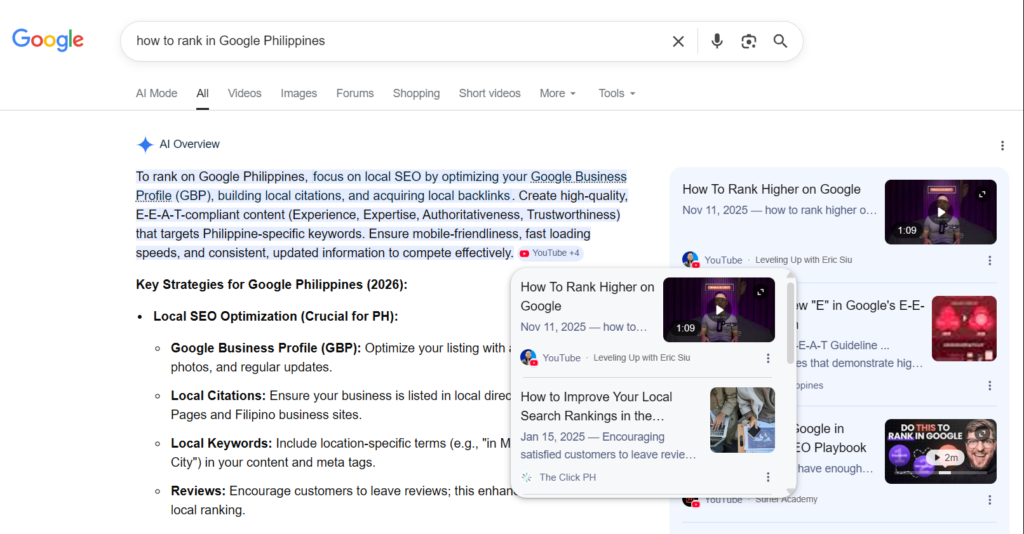
I’ve noticed this especially with informational queries. You search something like “what is SEO” or “how to rank in Google Philippines,” and you’ll often see AI-generated answers pulling snippets from multiple sites. Sometimes, users don’t even click anymore.
That’s exactly why the short vs. long content debate matters more today. As zero-click searches continue to rise, click-through rates for informational keywords are becoming more difficult to maintain. So for marketers, visibility within AI Overviews is now becoming just as important as traditional rankings. Because if users aren’t clicking, being cited may be one of the few ways to stay visible in search.
How Content Length Impacts AI Overview Citations
Here’s the thing: AI doesn’t prefer short or long content. It prefers useful content it can extract easily.
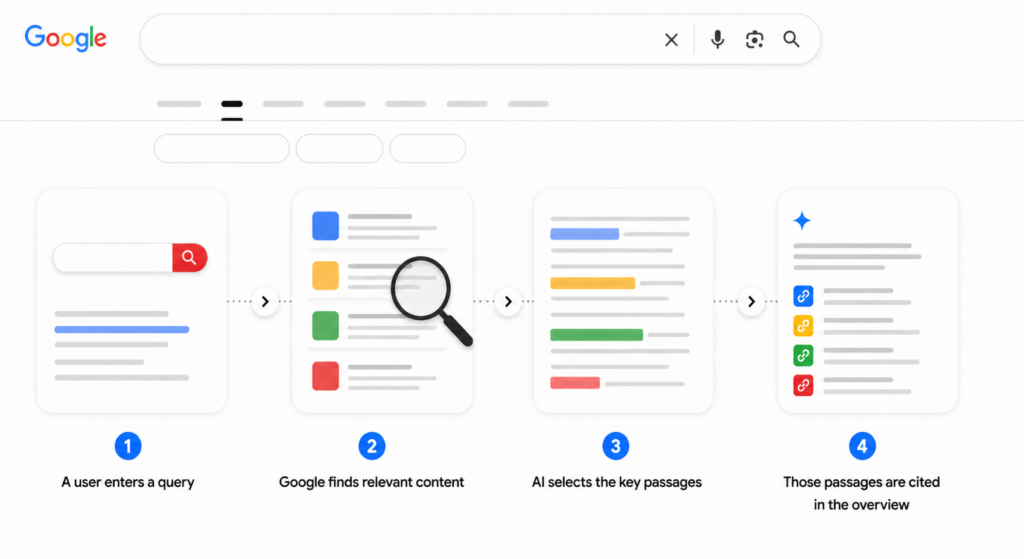
The process looks something like:
A user searches a query → Google identifies relevant passages → AI extracts the most useful chunks → Those chunks get cited in the overview
So where does content length come into play? Not as much as people think (at least not directly). What matters more is whether your content clearly answers the query, presents information in a way that’s easy to isolate, and is structured in a format AI can easily understand and extract.
In other words, content length only becomes relevant when it helps you create stronger, more citable sections. A longer article isn’t automatically better, and shorter content isn’t automatically favored. What matters is how effectively your content delivers the answer.
When Short-Form Content Performs Better for AI Overviews
There are definitely cases where short-form content performs better. When users are looking for quick, direct answers, concise content often has a better chance of being pulled into AI Overviews because the information is easier to extract and summarize.
Definition-Based Queries
For queries like “what is technical SEO,” users are typically looking for a quick and straightforward definition, not a lengthy breakdown right away. Because of this, AI Overviews often pull concise sections that answer the question immediately in one or two clear sentences.
If your definition is buried under long introductions or unnecessary fillers, there’s a higher chance AI will source a cleaner answer from another website instead. This is where short-form, answer-first content can have an advantage.
FAQ-Driven Searches
Content that follows straightforward question-and-answer formats such as “What is SEO?” tends to perform well in AI Overviews because it mirrors how users naturally search for information.
This type of structure makes it easier for AI systems to identify clear answers, extract relevant sections, and surface them quickly in generated responses.
Local or Transactional Searches
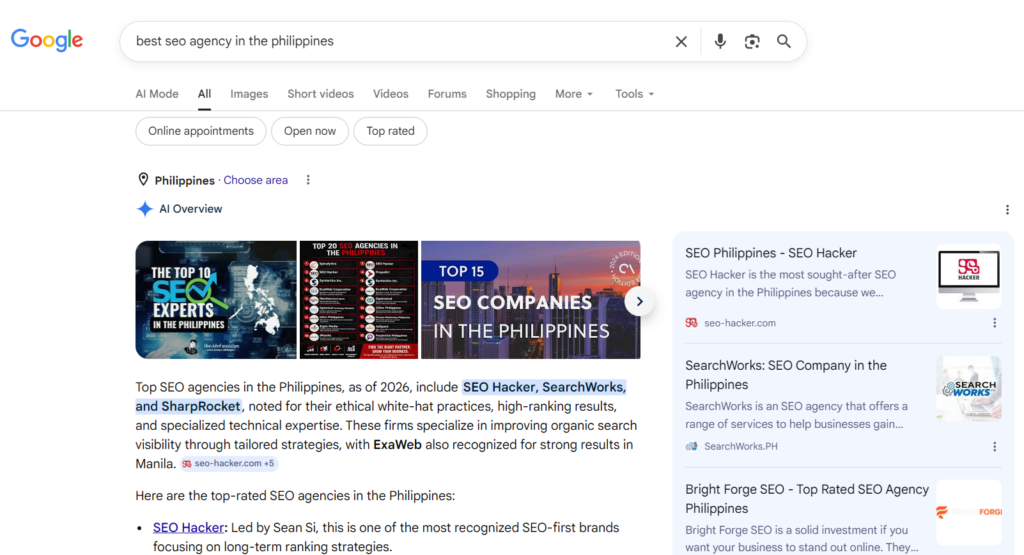
The same applies to transactional or local-intent queries like “SEO services philippines price” or “best SEO agency in the philippines.” Users searching these terms usually want quick comparisons, pricing details, or direct recommendations.
In these cases, concise content with clear pricing breakdowns, service lists, or direct answers tends to be more useful for both users and AI systems. The easier your content is to scan and extract from, the higher the chances of being surfaced in AI-generated results.
Quick-Answer Informational Queries
Simple queries like “how many keywords per page” or “what is CTR” are often better suited for short, direct responses because users typically want quick answers they can understand immediately.
Therefore, for these instances, lengthy explanations can sometimes dilute the main point and make it harder for AI systems to identify the most relevant response.
When Long-Form Content Still Wins AI Visibility
Now, this doesn’t mean long-form content is dead. Far from it. In fact, I still rely on long-form content a lot, especially for more complex topics.
Complex Educational Topics
If you’re covering a broader topic like “how SEO works,” a short answer usually isn’t enough to fully address what users are looking for. Most people searching this query want a deeper understanding of the process, not just a basic definition.
This often requires multiple layers of explanation. So in cases like this, long-form content gives you more room to provide meaningful context while still creating sections that AI can cite.
Comparison-driven Searches
Queries like “SEO vs SEM” or “Ahrefs vs SEMrush” typically require more than a quick summary because users are often comparing multiple factors before making a decision. They usually want clear breakdowns of differences in features, pricing, use cases, benefits, and limitations.
Long-form content works well here because it allows you to organize these comparisons in a way that is both comprehensive and easy to scan. Structured sections, comparison tables, and concise summaries can also give AI Overviews multiple opportunities to pull relevant insights.
High-consideration B2B Queries
If someone is searching for enterprise SEO solutions, they’re usually making a high-stakes business decision and need more than a quick 100-word response. They’re often looking for detailed information on strategy, scalability, pricing, implementation, and whether a solution aligns with their business goals.
In situations like this, long-form content helps address deeper concerns and provides the level of detail users expect before taking action. It also creates more opportunities for AI systems to pull specific sections that answer different parts of the query.
Building Topical Authority
This is where long-form content really stands out. It allows you to naturally reinforce important SEO elements such as relevant entities, stronger internal linking opportunities, and greater semantic depth by covering related subtopics more comprehensively.
When done well, this creates stronger topical authority and gives AI systems more contextual signals to better understand your content.
What AI Overviews Actually Prioritize Over Word Count
If there’s one thing I’ve learned, it’s this: structure beats length.
Here’s what really matters:
- Direct Answer Placement – Always give a clear answer right after your heading. If users or AI systems have to scroll through long introductions before finding the actual answer, there’s a higher chance another source gets cited instead.
- Content Chunking – Break your content into smaller, digestible sections that are easy to scan. Personally, I try to keep paragraphs around 40–60 words because shorter sections make it easier for both readers and AI systems to scan key information.
- Structured Formatting – Lists, bullet points, comparison tables, and Q&A formats tend to perform well because they present information in a clean, organized way. These formats make it easier for AI Overviews to extract specific answers quickly.
- E-E-A-T Signals – Trust still matters. From my experience, adding real examples, original insights, case studies, and demonstrating firsthand expertise makes content more credible and valuable, especially in competitive industries.
- Freshness – Regularly updating your content can make a difference, particularly for topics tied to trends, tools, pricing, or changing search behavior. AI tends to favor content that reflects current trends and data.
Priority What to Do Example Direct Answers Use short paragraphs 40–60 words per block Chunking Use short paragraphs 40–60 words per block Formatting Use lists & Q&A Bullet points, FAQs E-E-A-T Show expertise Case studies, author bio Freshness Update regularly Add new data or examples
The Best Content Strategy: Hybrid Content That Serves Both Search and AI
If you ask me what works best today, it’s rarely a choice between short-form or long-form content. It’s usually a strategic combination of both. What I’ve found most effective is creating content that immediately answers the query while still offering enough depth for users who want to learn more.
This is why I now follow an answer-first approach:
- Start with a direct answer – Right after the heading, I provide a concise response within the first 100–150 words. This gives AI systems a clear snippet to extract while immediately addressing user intent.
- Expand with deeper context – Once the core answer is established, I build out the rest of the content with valuable supporting details, such as:
- Real-world examples
- Case studies or data points
- Step-by-step processes
- Comparisons
- Common mistakes or best practices
- Use a structured format – I typically organize content in a way that works for both AI extraction and user readability:
- Quick answer
- Detailed explanation
- Supporting sections or subtopics
- FAQs
- Final summary or key takeaways
This approach works well because it gives AI Overviews a clear, concise answer to cite while still providing the comprehensive information users expect once they land on your page.
Key Takeaway
Short content works when users want quick answers. Long content works when they need depth. But from what I’ve seen in actual SEO work, neither format consistently wins on its own. It always depends on how well the content matches user intent.
The real advantage comes from creating content that’s clear, well-structured, and easy for AI systems to extract. Instead of asking whether short or long content is better for AI Overviews, the better question is whether your content delivers the most relevant answer in the most accessible format.
